
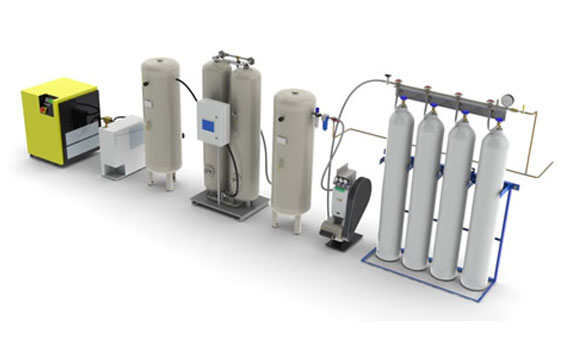
You may want to know what the relationship between water treatment and industrial oxygen is, but in fact, using on-site oxygen generators can make the water treatment process more sustainable and efficient. Let's learn together why water needs to be treated and the water treatment process, as well as how industrial gases play a role in purifying water.
-The goal of water treatment
When we think of water quality, we usually think of drinking water, but water is not just the water we drink. Wastewater, streams, lakes, and other water bodies all indirectly play a role in our daily lives. When trying to control the water quality, there will be many challenges, such as natural disasters, rainstorm, recreational activities, fires and other factors related to water will affect the purity of water.
When considering how to improve water quality, everything comes down to protecting the source of water. In order to determine what should be done to protect water, quality testing, analysis, and benchmarks have been set to evaluate areas for improvement. Continuous monitoring and maintaining good water quality will always be the main goal of the water treatment department.
-The basic process of water treatment
Through mechanical and chemical process: water is treated to remove any contaminants and pollutants. There are a series of pollutants in water, including bacteria, organic compounds, fungi, minerals, metals, and other unhygienic elements that may make us sick. That's why there is a water treatment process to recycle and clean our water.
1.Coagulation: Adding compounds to the water flowing through the treatment plant to remove dirt particles and other particles from the water. The added compound acts like a magnet, attracting particles from the water.
2.Sedimentation: Next, the "magnetized" particles sink to the bottom of the water tank, allowing the water to filter to the next stage.
3.Filtration: Then, the water is further purified through a biological process through the filtration process. This is achieved by passing water through a series of water tanks containing sand, gravel, and charcoal filters. The use of these natural filtration methods is to avoid the use of additional chemicals. These filters can remove bacteria and any other small solid particles.
4.Disinfection: Normally, chlorine gas is added to disinfect the water to kill any remaining bacteria and microorganisms.
5.Storage: After disinfection, water flows through pipelines to your home or company.
Air separation plant,Oxygen plant,PSA Oxygen generator,industrial air separation plant,nitrogen plant,ASU,Oxygen tank,ISO tank,storage tank,semi-trailer tank,Oxygen Cylinder,Liquid nitrogen dewar

Alternative chemical treatment options: aeration and carbon dioxide purification
According to the American Chemical Council, oxygen and carbon dioxide are most commonly used in the treatment of wastewater, drinking water and other water bodies such as lakes and streams. Recently, there have been some new innovations to enhance the purification process by using carbon dioxide to generate chemical gradients, which helps to separate impurities that cannot be completely removed by traditional chemical process.
Purification method: Many times, during the disinfection stage of the water treatment process, chemicals such as chlorine gas are used, but there are already alternative methods that use carbon dioxide for better disinfection of water. The second, third, and fourth steps in the above treatment process are all in the form of water purification, which may be expensive and may not be able to remove small impurities.
Researchers have discovered a method of using carbon dioxide dissolved in water, which essentially charges and separates microorganisms from purified water streams. This process creates a chemical gradient in the water, which helps to separate 99.9% of impurities. This process is more efficient in energy conservation, more effective, and easy to mass produce, which can reduce cost.
In addition, high-purity oxygen is also used for Aerobic digestion, oxygen enhanced aeration and odor control. Aeration is an alternative method for chemical treatment of water, which can generate the same water benefits as chemical treatment without the need to add additional chemicals to the water supply.
Aeration: The role of bacteria in wastewater is to decompose organic matter and convert it into carbon dioxide and water. During the coagulation process, oxygen can be pumped into the water tank to help bacteria grow. Bacteria can decompose organic matter on their own, but this process takes too long and leads to the production of hydrogen sulfide, ultimately turning into methane. That's why aeration is an important part of the water treatment process.
Through aeration, bacteria consume organic matter, including soil and other organic materials inhabited by animals. This process produces the magnetic effect we mentioned above, which attracts these substances and then sinks to the bottom of the water tank. When oxygen is added to water, this ultimately helps to more effectively decompose the particles in the water and prevent the generation of hydrogen sulfide and methane gases in the water.
Through these alternative methods of using industrial gases, water treatment can achieve the final result more effectively and safely for those who consume or use water. With these methods, there may be more opportunities in the future to provide cleaner water to third world countries, as scientists are working to simplify this process and make it more cost-effective.