
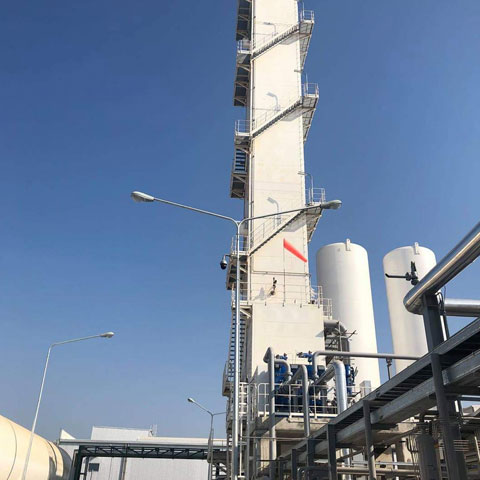
Argon is a colorless, odorless, monatomic gas with a relative atomic mass of 39.948. Generally, argon is produced by fractional distillation after liquefaction of air. Argon is 1.4 times denser than air and 10 times denser than helium. Argon is an inert gas that does not react chemically with other substances at room temperature, and is also insoluble in liquid metals at high temperatures. It can show its superiority when welding non-ferrous metals. Can be used for bulb gas filling and arc welding of stainless steel, magnesium, aluminum, etc., that is, "argon arc welding"
Main application
Argon is a rare gas widely used in industry. It is very inert in nature and neither burns nor supports combustion. In aircraft manufacturing, shipbuilding, atomic energy industry and machinery industry, for special metals such as aluminum, magnesium, copper and its alloys and stainless steel, argon is often used as a welding shielding gas during welding to prevent the welded parts from being oxidized or nitrided by air.
- Aluminum industry. Used to replace air or nitrogen to create an inert atmosphere during aluminum manufacturing; to help remove unwanted soluble gases during degassing; and to remove dissolved hydrogen and other particles from molten aluminum.
- Steelmaking. Used to displace gases or vapors and prevent oxidation in process flow; used to stir molten steel to maintain constant temperature and uniform composition; to help remove unwanted soluble gases during degassing; as a carrier gas, argon can be used in layers Analytical methods are used to determine the composition of the sample; argon is also used in the Argon Oxygen Decarburization (AOD) process used in stainless steel refining to remove carbon monoxide and reduce loss of chromium.
- metal processing. Argon is used as an inert shielding gas in welding; to provide oxygen- and nitrogen-free protection in the annealing and rolling of metals and alloys; and to flush molten metal to eliminate porosity in castings.
- Welding shielding gas. Argon is used as a shielding gas in the welding process, which can avoid the burning of alloying elements and other welding defects caused by it, so that the metallurgical reaction in the welding process becomes simple and easy to control, so as to ensure the high quality of welding. [4] Through the laser remelting test of HT250 gray cast iron, the generation mechanism of pores in the remelting zone of the sample under different atmosphere protection conditions was studied. The results show that under argon protection, the pores in the remelting zone are precipitation pores; under open conditions, the pores in the remelting zone are precipitation pores and reactive pores.
- Other uses. Electronics, lighting, argon knife, etc.
Preparation
The content of argon in dry air is about 0.934%, and the argon content in synthetic ammonia tail gas is 3% to 8%. In industry, argon is generally extracted from air and synthetic ammonia tail gas.
Air separation to extract argon
The main products of cryogenic air separation are pure oxygen and pure nitrogen, and its by-products are the main source of argon production. The argon fraction (containing 8%~12% Ar) is extracted from the distillation column of the air separation unit, which contains oxygen and nitrogen and other components. The argon production process includes conventional argon production and full rectification argon production, and pure argon production. The preparation is mainly to remove impurities such as oxygen, nitrogen and hydrogen in the argon fraction. [8]
Extraction of argon from synthetic ammonia tail gas
Synthetic ammonia tail gas is composed of its relaxation gas and ammonia tank exhaust gas, and its composition is: 60%~70%H2, 20%~25%N2, 3%~8%Ar, 8%~12%CH4 and about 3%NH3 . There are three types of argon stripping from synthetic ammonia tail gas: cryogenic rectification and condensation evaporation. Typical processes include three-column argon stripping process, two-column argon stripping process and circulating argon stripping device with heat pump. The production process includes raw material gas purification, dehydrogenation, and demethanization. and denitrification four-step process
Disposal storage
Argon gas can be stored and transported in liquid form at temperatures below -184°C, but argon gas for welding is mostly used in steel cylinders.
The argon cylinder is a steel cylindrical high-pressure container, the outer surface of which is painted gray and marked with the word "argon" in green.
When the argon cylinder is in use, it is strictly forbidden to knock, collide, or freeze the cylinder valve, and it is not allowed to bake it with fire; it is not allowed to transport the argon cylinder with an electromagnetic lifting machine; it should be protected from sunlight in summer; the gas in the cylinder can not be used up and return to the factory The residual pressure of the argon cylinder should not be less than 0.2MPa; the argon cylinder is generally placed upright