
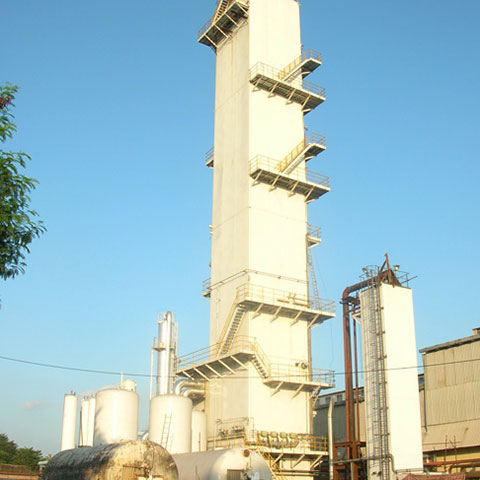
The content of argon in dry air is about 0.934%, and the argon content in synthetic ammonia tail gas is 3% to 8%. In industry, argon is generally extracted from air and synthetic ammonia tail gas.
Air separation to extract argon
The main products of cryogenic air separation are pure oxygen and pure nitrogen, and its by-products are the main source of argon production. The argon fraction (containing 8%~12% Ar) is extracted from the distillation column of the air separation unit, which contains oxygen and nitrogen and other components. The argon production process includes conventional argon production and full rectification argon production, and pure argon production. The preparation is mainly to remove impurities such as oxygen, nitrogen and hydrogen in the argon fraction.
Extraction of argon from synthetic ammonia tail gas
Synthetic ammonia tail gas is composed of its relaxation gas and ammonia tank exhaust gas, and its composition is: 60%~70%H2, 20%~25%N2, 3%~8%Ar, 8%~12%CH4 and about 3%NH3 . There are three types of argon stripping from synthetic ammonia tail gas: cryogenic rectification and condensation evaporation. Typical processes include three-column argon stripping process, two-column argon stripping process and circulating argon stripping device with heat pump. The production process includes raw material gas purification, dehydrogenation, and demethanization. and denitrification four-step process.
Disposal storage
Argon gas can be stored and transported in liquid form at temperatures below -184°C, but argon gas for welding is mostly used in steel cylinders.
The argon cylinder is a steel cylindrical high-pressure container, the outer surface of which is painted gray and marked with the word "argon" in green.
When the argon cylinder is in use, it is strictly forbidden to knock, collide, or freeze the cylinder valve, and it is not allowed to bake it with fire; it is not allowed to transport the argon cylinder with an electromagnetic lifting machine; it should be protected from sunlight in summer; the gas in the cylinder can not be used up and return to the factory The residual pressure of the argon cylinder should not be less than 0.2MPa; the argon cylinder is generally placed upright.
Storage Notes
To store in a ventilated warehouse, away from fire and heat sources. The gas cylinders should have anti-falling measures. Cryogenic liquid storage tanks larger than 10 cubic meters cannot be placed indoors. Bottled gas products are high-pressure filling gas, which should be decompressed and depressurized before use. All the gas cylinders have an expiration date on them, and all expired gas cylinders must be sent to a department for safety inspection before they can continue to be used. When the exhaust gas of each bottle of gas is used, the residual pressure in the bottle should be kept at 0.5MPa, and the minimum residual pressure should not be lower than 0.25MPa. The bottle valve should be closed to ensure gas quality and safe use. Bottled gas products should be classified and stacked during transportation, storage and use. It is strictly forbidden to stack combustible gas and combustion-supporting gas together. It is not allowed to be close to open flames and heat sources. , Do not hit, it is strictly forbidden to start arc or arc on the gas cylinder, and it is strictly forbidden to load and unload it brutally.
Fire attention
Extinguishing method: This product is not flammable. Cut off the air supply. Cool containers with water spray and move containers from fire to open space if possible.
Storage and transportation precautions
In the process of storage and transportation, it should be lightly loaded and lightly unloaded to prevent damage and high temperature. Argon is not corrosive, and can use carbon steel, stainless steel, copper, copper alloys and other general metal materials and general plastic materials and elastic materials at room temperature. Polytetrafluoroethylene and polychlorotrifluoroethylene polymers are commonly used as gaskets, diaphragms, etc. at low temperatures.
Emergency measures
Hazardous characteristics, in case of high heat, the internal pressure of the container will increase, and there is a risk of cracking and explosion.
Extinguishing method, this product is not flammable, choose an appropriate fire extinguisher according to the cause of the fire.
If there is a large amount of leakage, a warning area should be delineated according to the influence area of gas diffusion, and irrelevant personnel should be evacuated from the crosswind and upwind to the safe area. Emergency personnel should wear positive pressure self-contained breathing apparatus, general work clothes, and cold-proof clothing when liquefied gas leaks.