
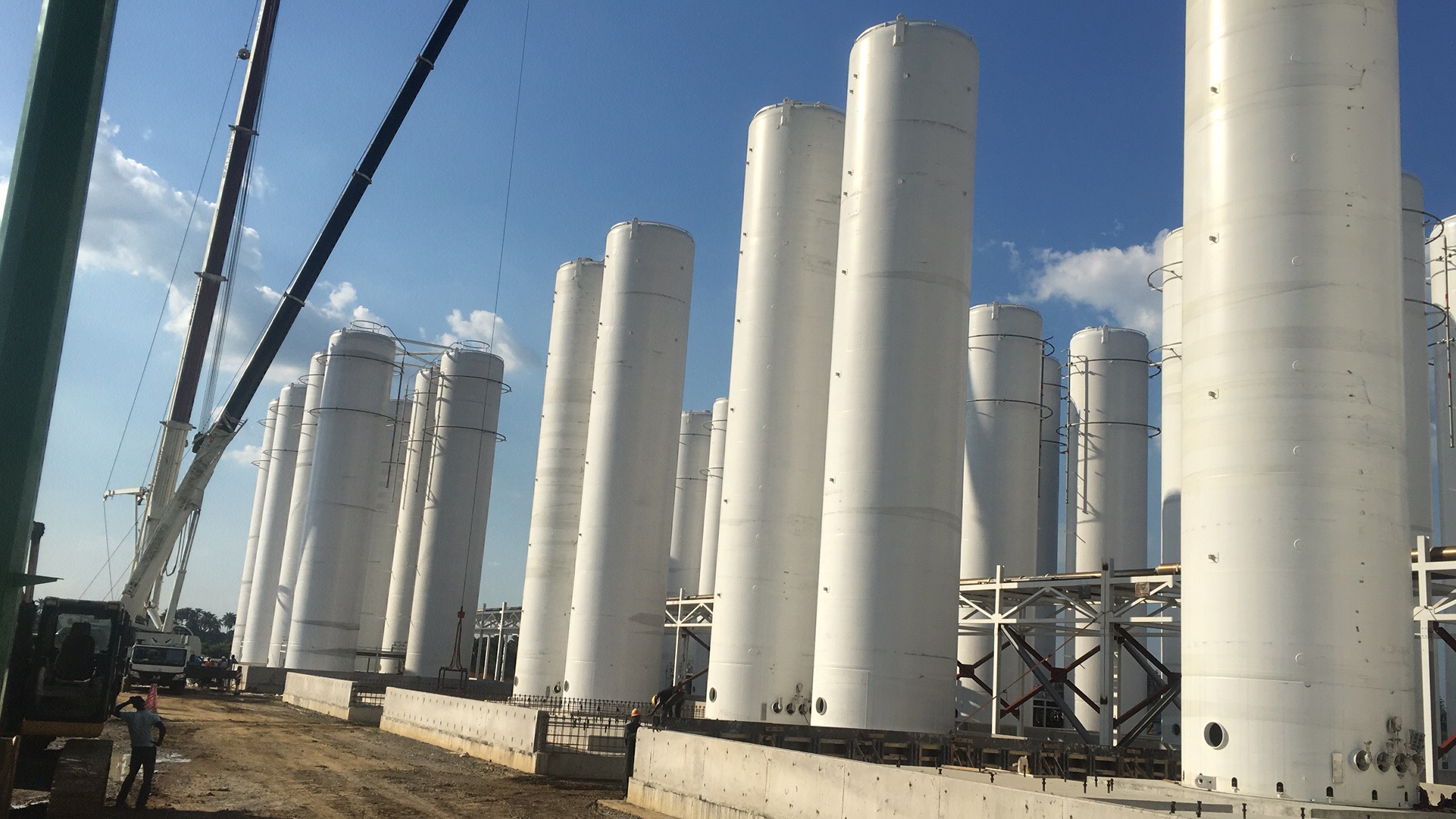
The gaseous environment on the earth contains 21% oxygen. It can be said that without oxygen, there will be no living things, and our blue planet will not have such a prosperous ecological civilization. Liquid oxygen (commonly referred to by the abbreviation LOX or LO2) is a liquid in which the oxygen state is liquid, a light blue liquid, and has strong paramagnetic properties.
The main physical properties of liquid oxygen include: density of 1.141 t/m3 (1141kg/m3) under normal atmospheric pressure (101.325 kPa), freezing point of 50.5 K (-222.65 °C), and boiling point of 90.188 K (-182.96 °C).
It has important applications in aerospace, submarine and gas industries.
However, due to some of its chemical and physical properties, liquid oxygen also has great safety hazards:
First, liquid oxygen has a fire hazard. Although it is non-flammable, it can strongly support combustion, and the fire hazard is Class B.
Liquid oxygen and fuel contact will usually not spontaneously ignite, but if the two liquids come into contact, the liquid oxygen will cause the liquid fuel to cool and solidify. The mixture of solidified fuel and liquid oxygen is very sensitive to impact and often detonates when pressurized.
There are generally two types of combustion reactions: 1) the fuel and liquid oxygen do not ignite when mixed, but the mixture can detonate when ignited or subjected to mechanical shock; 2) combustion begins before or during contact with the liquid oxygen and fuel, and fires or burns with repeated explosions.
Second, liquid oxygen is explosive.
All combustible substances (including gases, liquids, and solids) present an explosion hazard when mixed with liquid oxygen. Such mixtures often explode due to static electricity, mechanical shock, electrical sparks and other similar effects, especially when the mixture is solidified.
When the liquid oxygen is accumulated in the closed system and cannot be kept warm, pressure damage may occur. When the temperature rises to -118.4 °C without increasing the pressure, the liquid oxygen cannot maintain a liquid state. If the pressure is not released in time, it will also cause a physical explosion.
Liquid oxygen builds up between the two valves and can cause violent damage to the line. If the oxygen does not escape or the pressure is not properly vented, when the freezing fails, the tank will be destroyed and the vacuum in the vacuum jacketed tank will fail.
If the system cannot be subjected to additional loads, it will cause accelerated evaporation and destruction of the evacuation system, resulting in an explosion.
Third, liquid oxygen may cause frostbite to personnel.
The boiling point of liquid oxygen is extremely low (-183°C).
Fourth, liquid oxygen may cause oxygen poisoning accidents.
Oxygen in the air is about 21%. Under normal pressure, when the concentration of oxygen exceeds 40%, it may cause oxygen poisoning. When inhaling a mixed gas with an oxygen concentration of 40% to 60%, there will be retrosternal discomfort, light cough, and then chest tightness, retrosternal burning, difficulty breathing, aggravated cough, etc. In severe cases, edema may occur, and even respiratory distress syndrome may occur. .
When inhaling a mixed gas with an oxygen concentration of more than 80%, it will cause facial muscle convulsions, coma, respiratory failure and death. Long-term exposure to an environment with an oxygen partial pressure of 60kpa~100kpa (equivalent to 40% oxygen concentration) will cause eye damage, and even blindness in severe cases.
Therefore, in the process of using liquid oxygen, we must be cautious and must not be careless!
- During the transportation and use of liquid oxygen, oil, smoking, and parking with open flames and flammable substances such as cars and motorcycles are strictly prohibited. Operators must also hold certificates.
- Before the liquid oxygen tank is put into use, the system should be tested for pressure, degreased and purged with oil-free dry nitrogen gas. When the dew point of the gas in the tank is not higher than -45℃, it can be put into use.
- During transportation, the oxygen temperature of the liquid oxygen vaporizer should be strictly monitored (should not be lower than -10℃). When liquid oxygen is sealed and stored, someone must also monitor the pressure, and no overpressure is allowed.
- It is strictly forbidden to place flammable and explosive substances and all sundries near the liquid oxygen discharge port. The ground near the liquid oxygen discharge port should not be constructed with flammable and explosive materials (adding asphalt, etc.).
- After confirming that the residual liquid and gas are exhausted, the vent valve must be closed. If the vent valve is not closed in time, the water vapor in the air will enter the cold pump body, and the condensed water vapor may affect the next use of the pump and cause Abnormal wear of packings.
- The filling rate of the liquid oxygen storage tank shall not be greater than 95%, and overfilling is strictly prohibited.
- Regularly analyze the acetylene concentration in liquid oxygen (usually about 7-15 days), and control its concentration below 0.1×10⁻⁶, otherwise liquid oxygen should be discharged.
- When in contact with liquid oxygen, protective measures must be taken. Liquid oxygen is not allowed to splash on unprotected skin to avoid serious frostbite.
Liquid oxygen also has many advantages that make it widely used in modern industrial production and military. For example, the volume is small, the transportation task is small; the total expansion ratio is as high as 860:1, and the utilization rate is also higher than that of oxygen. The future is bright.