
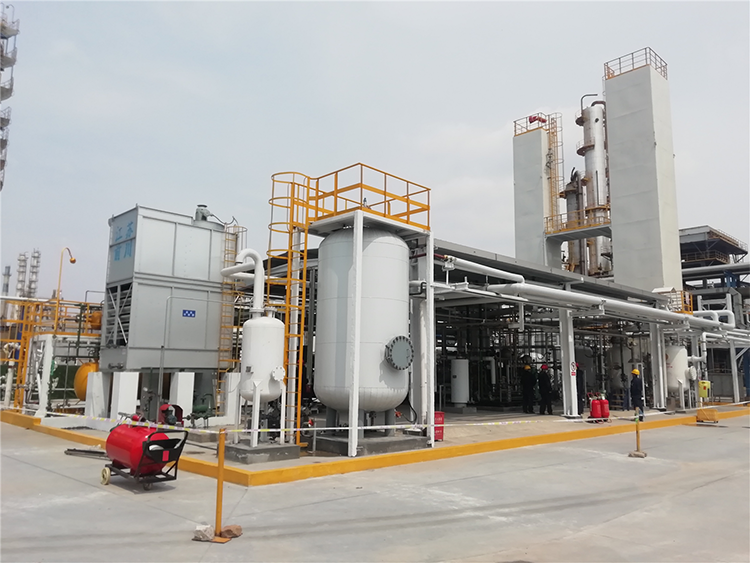
The development of carbon dioxide capture, storage, and utilization (CCUS) technology and the expansion of its application scenarios have also attracted widespread attention for achieving carbon dioxide capture based on adsorption technology. Among them, the development of low-cost and high-efficiency carbon dioxide adsorbent materials has become one of the current research and industrialization hotspots.
Solid adsorbent materials are environmentally friendly
Adsorption technology is a relatively mature and widely used technology in the separation and capture of carbon dioxide. Adsorption technology has the advantages of low energy consumption, simple operation, large adsorption capacity, and good cycling performance. There are many types of carbon dioxide adsorbent materials that are compatible with adsorption technology. Overall, they can be divided into solid adsorbent materials and liquid adsorbent materials.
Professor Zhang Youfa from the School of Materials Science and Engineering at Southeast University introduced that solid adsorbent materials have weak corrosiveness, low adsorption energy consumption, and advantages such as safety and environmental friendliness. Applying them to carbon dioxide capture and concentration has good results. Solid adsorbent materials also include high-temperature adsorbent materials and low-temperature adsorbent materials. Among them, high-temperature adsorbent materials, represented by calcium oxide adsorbent materials, can adsorb carbon dioxide at temperatures up to 600 ℃. Due to the fact that calcium oxide adsorbent materials belong to alkaline substances and carbon dioxide belongs to acidic gases, they can easily adsorb carbon dioxide. These two substances generate calcium carbonate through chemical reactions.
Low temperature adsorbent materials include activated carbon, zeolite, etc., which not only cannot adsorb carbon dioxide at higher temperatures, but also have advantages such as good carbon dioxide adsorption efficiency and regeneration performance. Taking zeolite as an example, it is a natural silicate aluminum salt that exists in nature. It has nanoscale uniform pore size, forms interconnected channels and network structures, and has functions of screening molecules, adsorption, ion exchange, and catalysis. Artificially synthesized zeolite is also known as molecular sieve. The adsorption of molecular sieves is a physical process that generates a "surface force" on solid surfaces through molecular gravity. When carbon dioxide gas flows through, the molecules in it collide with the surface of the adsorbent material and aggregate, thereby reducing the number of molecules in the gas and achieving the purpose of separation and removal. Since adsorption does not undergo chemical changes, as long as efforts are made to "drive away" the molecules gathered on the surface, the "regenerated" molecular sieve will once again have adsorption capacity.
Low cost of liquid adsorbent materials
As one of the manufacturers of carbon dioxide adsorbent materials, Gao Yuejing, Chairman of Xi'an Lanxiao Technology New Materials Co., Ltd. (hereinafter referred to as Lanxiao Technology), said that currently, solvent adsorption is the main industrialized carbon dioxide capture technology worldwide, with liquid organic amine compounds as the core adsorbent material. Liquid amine has good adsorption effect and low cost, but high regeneration energy consumption and significant corrosion to equipment.
However, with the advancement of technology, liquid adsorbent materials are also constantly being improved and optimized. The article "Research Status and Prospects of Carbon Dioxide Adsorption and Separation by Loaded Ionic Liquids" published by scientific researchers from the School of Chemical Engineering of Zhengzhou University, the Institute of Process Engineering of the Chinese Academy of Sciences and other units shows that ionic liquids have gradually shown unique advantages in the field of carbon dioxide capture and separation due to their extremely low volatility, strong gas affinity, adjustable structural properties and other characteristics. However, ionic liquids usually have high viscosity or remain solid at room temperature, resulting in poor adsorption efficiency or inability to be directly applied in adsorption separation processes.
Load type ionic liquids are formed by combining ionic liquids with organic or inorganic porous materials through physical or chemical methods. As a carbon dioxide adsorbent material, loaded ionic liquids have the common advantages of both ionic liquids and porous materials. They can not only improve the selective separation effect, but also effectively avoid the high viscosity problem of direct absorption of carbon dioxide by ionic liquids, thereby improving the efficiency of carbon dioxide adsorption. Supported ionic liquids can be divided into physical supported ionic liquids and chemical supported ionic liquids by different combination modes of ionic liquids and carriers. Their synthesis methods are usually immersion method, bonding method, sol gel method, etc. Porous materials combined with ionic liquids mainly include silicon-based materials, polymers, activated carbon, zeolites, and metal organic frameworks.
New types of adsorbent materials continue to emerge
Currently, China is continuously making new breakthroughs in the research and development of carbon dioxide adsorbent materials. The research group led by Professor Liu Xiaoqin and Professor Sun Linbing from the School of Chemical Engineering at Nanjing University of Technology has developed an intelligent photoresponsive adsorbent material, which achieves low energy consumption and controllable capture of carbon dioxide. The relevant research results have been published in the internationally renowned journal "German Applied Chemistry".
In industrial adsorption and separation operations, traditional adsorbent materials usually need to be recycled under variable temperature or pressure conditions, that is, adsorption at room temperature, desorption during heating, or adsorption under pressure and desorption after decompression. But the problem is that the energy consumption of this adsorption desorption process is high, "said Sun Linbing. The material can adsorb carbon dioxide, and the material itself must have adsorption active sites, otherwise selective adsorption cannot be achieved.
In order to reduce the energy consumption of the adsorption desorption process, the research team introduced photoresponsive components such as azobenzene into the adsorbent material, which interacted with the active sites. Under different light conditions, the configuration of the responsive molecules changed, and the properties of the active sites were adjusted to achieve the adsorption and desorption of carbon dioxide.
Air Separation Plant/Nitrous oxide plant/CO2 recovery plant/Hydrogen plant/Acetylene Plant/Mobile Tank/ISO Tank Container/Cryogenic Storage Tank/LPG Storage Tank/Cryogenic Pump/Micro Bulk Tank Solutions/Cryogenic Semi Trailer Transport Tanker/LPG Semi Trailer Tanker/Dewar Flask/Vaporizer/Cylinders/Dry ice making machine/Calcium Carbide