
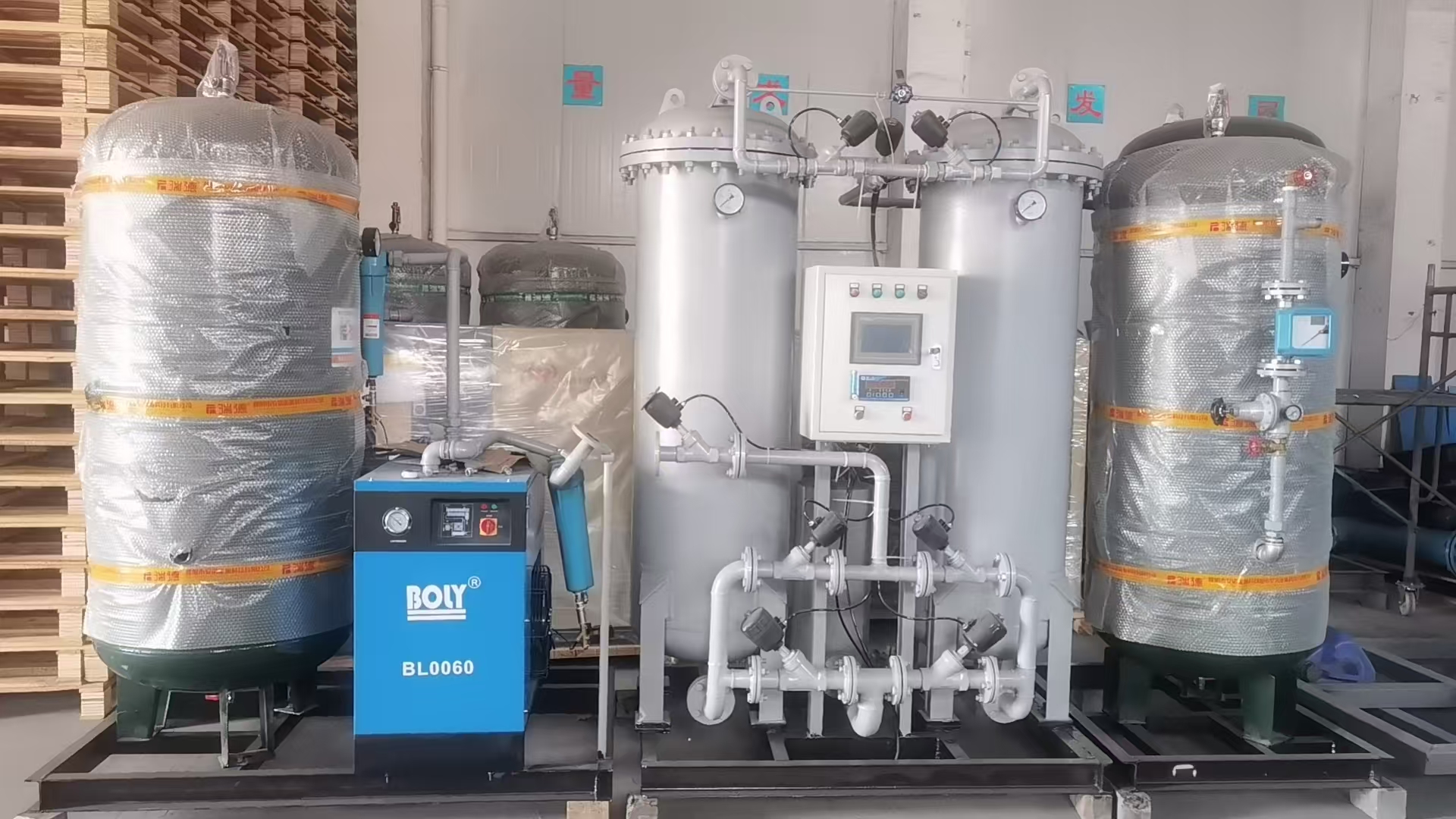
With the rapid development of industry, nitrogen has been widely used in fields such as chemical engineering, electronics, metallurgy, food, and machinery. China's demand for nitrogen is increasing at a rate of over 8% per year. The chemical properties of nitrogen are not active, and it exhibits great inertness in its normal state, making it difficult to undergo chemical reactions with other substances. Therefore, nitrogen is widely used as a protective gas and sealing gas in the metallurgical industry, electronic industry, and chemical industry. The purity requirement for protective gas is generally 99.99%, and some require high-purity nitrogen above 99.998%. Liquid nitrogen is a convenient cold source and is increasingly being used in the food industry, medical industry, and animal husbandry for semen storage.
Cryogenic nitrogen production
This method first compresses, cools, and liquefies the air, and utilizes the different boiling points of oxygen and nitrogen components (oxygen has a boiling point of 90K and nitrogen has a boiling point of 77K at atmospheric pressure) to make the gas on the tray of the distillation tower Liquid contact involves mass and heat exchange, where high boiling point oxygen continuously condenses into liquid from steam, while low boiling point nitrogen continuously transfers into steam, increasing the nitrogen content in the rising steam and increasing the oxygen content in the downstream liquid. This separates oxygen and nitrogen, resulting in nitrogen or oxygen gas. This method is carried out at temperatures below 120K, hence it is called cryogenic air separation.
Here, it can be roughly divided into the following points:
(1) Air compression and purification
After passing through an air filter to remove dust and mechanical impurities, the air enters an air compressor, compressed to the required pressure, and then sent to an air cooler to lower the air temperature. Then enter the air drying purifier to remove moisture, carbon dioxide, acetylene, and other hydrocarbons from the air.
(2) After air separation and purification, the air enters the main heat exchanger in the air separation tower and is cooled to saturation temperature by the reflux gas (product nitrogen, exhaust gas). It is then sent to the bottom of the distillation tower, where nitrogen is obtained at the top of the tower. The liquid air is then throttled and sent to the condensing evaporator for evaporation. At the same time, a portion of the nitrogen sent from the distillation tower is condensed. A portion of the condensed liquid nitrogen is used as the reflux liquid of the distillation tower, while the other portion is used as liquid nitrogen product and discharged from the air separation tower. The exhaust gas from the condenser evaporator is reheated to about 130K by the main heat exchanger and enters the expansion machine for expansion and cooling to provide cooling for the air separation tower. A portion of the expanded gas is used for the regeneration and blowing of molecular sieves, and then discharged into the atmosphere through a muffler.
(3) Liquid nitrogen vaporization
The liquid nitrogen from the air separation tower is stored in a liquid nitrogen storage tank. When the air separation equipment is under maintenance, the liquid nitrogen in the storage tank enters the vaporizer and is heated before being sent into the product nitrogen pipeline.
Note: Cryogenic nitrogen production can produce nitrogen gas with a purity greater than 99.999%.
PSA pressure swing adsorption
The pressure swing adsorption (PSA) method is based on the selective adsorption of oxygen and nitrogen components in the air by adsorbents to separate the air into nitrogen gas. When air is compressed and passes through the adsorption layer of the adsorption tower, oxygen molecules are preferentially adsorbed, while nitrogen molecules remain in the gas phase and become nitrogen gas. When the adsorption reaches equilibrium, the oxygen molecules adsorbed on the surface of the molecular sieve are removed by depressurization, restoring the adsorption capacity of the molecular sieve, which is the desorption of the adsorbent. In order to continuously provide nitrogen gas, the device usually sets up two or more adsorption towers, one tower for adsorption and the other tower for analysis, and switches between use at appropriate times.
The general process of PSA nitrogen production is as follows:
After passing through an air filter to remove dust and mechanical impurities, the air enters the air compressor and is compressed to the required pressure. After strict oil, water, and dust removal purification treatment, clean compressed air is output to ensure the service life of the molecular sieve in the adsorption tower.
② There are two adsorption towers equipped with carbon molecular sieves, with one tower operating while the other tower is depressurized for desorption. Clean air enters the working adsorption tower, and oxygen, carbon dioxide, and water are adsorbed by molecular sieves. The gas flowing to the outlet end is nitrogen and trace amounts of argon and oxygen. The other tower (desorption tower) separates the adsorbed oxygen, carbon dioxide, and water from the micropores of the molecular sieve and releases them into the atmosphere. In this way, the two towers take turns to complete nitrogen oxygen separation and continuously output nitrogen gas. The purity of nitrogen produced by pressure swing adsorption is 95% -99.9%. If higher purity nitrogen is needed, a nitrogen purifier needs to be added.
Note: 95% -99.9% ammonia gas output from the pressure swing adsorption nitrogen generator enters the nitrogen purifier, and an appropriate amount of H2 is added through a flow meter. It undergoes catalytic reaction with trace oxygen in the nitrogen gas in the deoxygenation tower of the purifier to remove oxygen. It is then cooled by a water condenser, dehydrated by a steam water separator, and deeply dried by a dryer (two adsorption drying towers are alternately used: one adsorption drying dehydration, and the other heating desorption drainage) to obtain high-purity nitrogen gas (at this time, the purity of nitrogen gas can reach 6N or above).
Technical Comparison
- Process comparison
① Number of devices
The pressure swing adsorption nitrogen production process is simple with a small number of equipment, mainly consisting of air compressors, coolers, oil-water separators, molecular sieves, adsorption nitrogen generators, and gas storage tanks. The cryogenic nitrogen production process is complex with a large number of equipment, including air compressors, cooling steam water separators, molecular sieves, main heat exchangers, expanders, and distillation towers.
② Product types and purity
Cryogenic nitrogen production can not only produce nitrogen but also produce liquid nitrogen, meeting the process requirements for liquid nitrogen, and can be stored in liquid nitrogen storage tanks. When there is a nitrogen interruption load or when air separation equipment maintenance requires a pause in nitrogen production, the liquid nitrogen in the storage tank enters the vaporizer and is heated before being sent to the product nitrogen pipeline to meet the nitrogen demand of the process equipment. The operating cycle of cryogenic nitrogen production (referring to the interval between two large heating cycles) is generally more than 1 year, so cryogenic nitrogen production generally does not consider backup.
Pressure swing adsorption nitrogen production can only produce nitrogen gas. Without backup means, a single set of equipment cannot guarantee continuous long-term operation. Cryogenic nitrogen production can produce nitrogen gas with a purity of ≥ 99.999%. The purity of nitrogen is limited by factors such as nitrogen load, number of trays, tray efficiency, and oxygen purity in the liquid air, and the adjustment range is very small. Therefore, for a set of cryogenic nitrogen production equipment, the product purity is basically certain and difficult to adjust. The purity of nitrogen produced by pressure swing adsorption is generally within the range of 95% -99.9%. If higher purity nitrogen is needed, nitrogen purification equipment needs to be added. The purity of nitrogen is only affected by the nitrogen load of the product. Under other constant conditions, the higher the nitrogen discharge, the lower the purity of nitrogen; Conversely, the higher it is. Therefore, for a set of pressure swing adsorption nitrogen production equipment, as long as the load allows, the product purity can be adjusted freely between 90-99.9%.
③ Comparison of operational control
The cryogenic method is carried out at extremely low temperatures, and there must be a pre cooling start-up process before the equipment is put into normal operation. The start-up time is generally not less than 12 hours from the start of the expander to the required nitrogen purity; Before the equipment enters major maintenance, there must be a period of heating and thawing, usually 24 hours. Therefore, the cryogenic nitrogen production equipment should not be started and stopped frequently, and should be operated continuously for a long time.
When starting the pressure swing adsorption method, just press the button and within 30 minutes, qualified nitrogen products can be obtained. If high-purity nitrogen is needed, it can be purified by a nitrogen purification device in about 30 minutes to obtain 99.99% -99.9999% high-purity nitrogen. Just press the button to stop the machine. Therefore, pressure swing adsorption nitrogen production is particularly suitable for intermittent operation.
Note: Currently, advanced DCS (or PLC) computer control technology is generally used for cryogenic nitrogen production, achieving integrated control of central control, machine side, and on-site, which can effectively monitor the production process of the entire equipment. Pressure swing adsorption nitrogen production adopts intelligent fully automatic control, and nitrogen production can be carried out with just a button, without the need for dedicated personnel management.
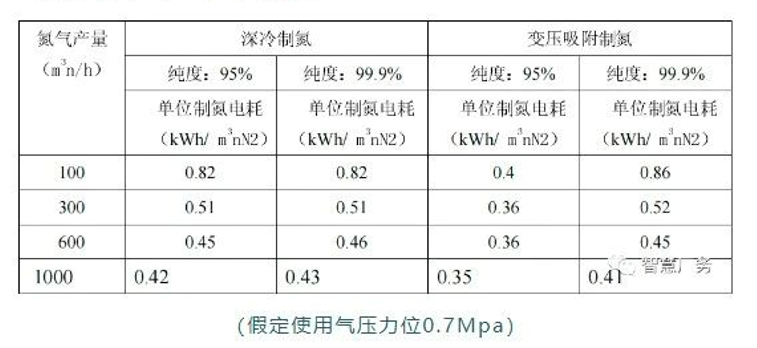
④ Comparison of Electricity Consumption for Unit Nitrogen Production
Unit nitrogen production electricity consumption is an important indicator reflecting the energy consumption of the entire equipment. For the production of high-purity nitrogen gas (purity above 99.9%), the unit electricity consumption of cryogenic nitrogen production and pressure swing adsorption nitrogen production is not significantly different; But for the production of nitrogen with lower purity, pressure swing adsorption nitrogen production has significant advantages in unit power consumption. As shown in the table below
⑥ Comparison of Infrastructure Costs
The number of pressure swing adsorption nitrogen production equipment is relatively small, the infrastructure cost is low, and the requirements for plant and equipment foundations are not high. The cryogenic nitrogen production equipment is relatively complex, with high installation requirements and long cycles, and requires a large amount of capital for the insulation box and insulation materials (pearlite sand), resulting in high infrastructure investment.
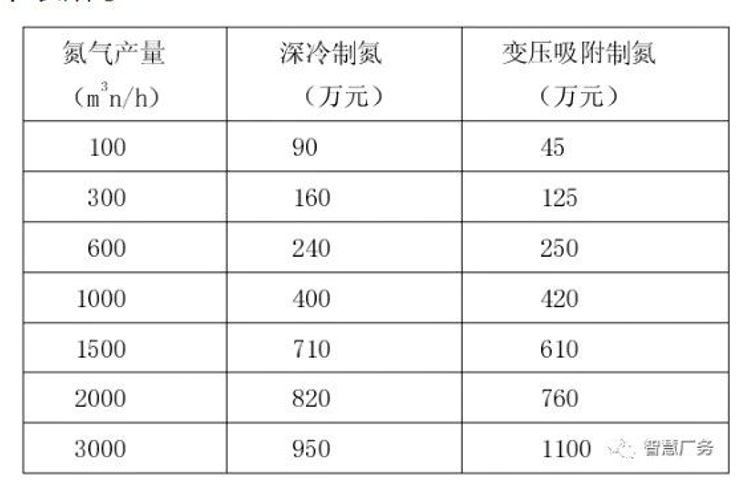
⑦ Comparison of Equipment Costs
According to the nitrogen usage of petrochemical plants, the table below compares the equipment costs for producing nitrogen with a purity of 99.9% and a pressure of 0.7MPa
⑧ Comparison of Maintenance Costs
Pressure swing adsorption nitrogen production itself is relatively simple, with a small number of operating machinery, operating at approximately normal temperature and pressure, requiring less maintenance work and lower costs. However, cryogenic nitrogen production operates at low temperatures and has more complex machinery, resulting in higher maintenance costs and time compared to pressure swing adsorption nitrogen production.
Overall, PSA is more suitable for operating under conditions of low purity, intermittent operation, low gas volume (approximately below 600), low budget, low specifications, and no need for liquid nitrogen as a backup, and vice versa for cryogenic methods.
Air Separation Plant/Nitrous oxide plant/CO2 recovery plant/Hydrogen plant/Acetylene Plant/Mobile Tank/ISO Tank Container/Cryogenic Storage Tank/LPG Storage Tank/Cryogenic Pump/Micro Bulk Tank Solutions/Cryogenic Semi Trailer Transport Tanker/LPG Semi Trailer Tanker/Dewar Flask/Vaporizer/Cylinders/Dry ice making machine/Calcium Carbide