
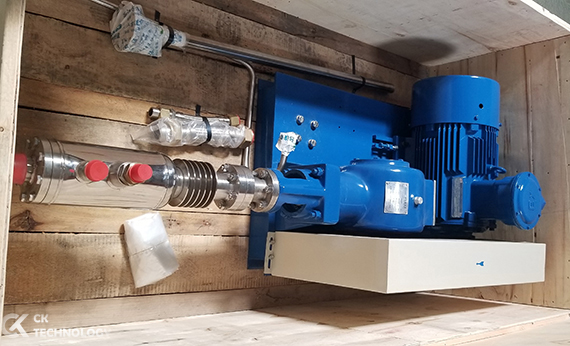
Cryogenic liquid pumps (referred to as cryogenic pumps) are special pumps used to transport cryogenic liquids (such as liquid oxygen, liquid nitrogen, liquid argon, liquid hydrocarbons and liquefied natural gas) in petroleum, air separation and chemical plants. In air separation, it is mainly used to transport liquid products, such as liquid oxygen pump, liquid nitrogen pump and liquid argon pump and other product pumps. Process pumps are also set up in the air separation process, for example: liquid oxygen circulation pump in the main cooling explosion-proof system; when the upper and lower towers are separated, the liquid oxygen at the bottom of the upper tower is sent to the main condensing evaporator at the top of the lower tower; the crude argon column is divided into crude argon column I and crude argon column II, and a liquid argon pump is arranged between the two columns. [1] According to different working principles, cryopumps are mainly divided into two types: reciprocating and centrifugal.
Cryogenic Liquid Pump Features
Its purpose is to transport cryogenic liquids from low pressure locations to high pressure locations. With the development of air separation technology, cryogenic liquids have been widely used and developed. Its only function in the air separation plant is: for liquid circulation; or to extract liquid from the storage tank and press it into the vaporizer, and then send it to the user after vaporization.
How Cryogenic Liquid Pumps Work
The working principle of centrifugal cryogenic liquid pump is the same as that of centrifugal water pump. Centrifugal pumps rely on the rotating impeller to perform work on the liquid and transfer the mechanical energy of the prime mover to the liquid. When the pump is filled with liquid, due to the high-speed rotation of the impeller, the liquid generates centrifugal force under the action of the impeller, which drives the liquid to increase in pressure energy and velocity energy in the process of flowing from the impeller inlet to the outlet, and then the velocity is increased in the diffuser chamber. It can be further converted into pressure energy and then output. Brief summary: The working principle of the centrifugal pump is: when the centrifugal pump is working, the liquid is continuously sucked into the pump by the pressure difference inside and outside the pump, and the liquid obtains kinetic energy by the high-speed rotation of the impeller; The kinetic energy of the liquid is converted into pressure energy. [1]
The working principle of the reciprocating cryopump is similar to that of the reciprocating compressor, and it is a positive displacement compressor. It uses the piston (plunger) to reciprocate in the working chamber of the liquid cylinder, so that the volume of the working chamber changes periodically to realize the whole process of suction-compression-discharge.
When the piston (plunger) moves to the right, the volume of the pump cylinder increases and the pressure decreases accordingly. When the liquid pressure in the inlet pipe is greater than the pressure in the pump cylinder, the suction valve opens and the liquid flows into the pump cylinder. When the crank rotates 180°, when the piston (plunger) moves to the left, the volume of the pump cylinder decreases. Because the liquid is an incompressible fluid, the pressure will rise rapidly. When the pressure rises to open the discharge liquid, the high pressure The liquid is discharged through the discharge valve, which is a working cycle of the reciprocating liquid pump. [1]
It can be seen that the flow of the reciprocating pump is pulsating and discontinuous. The number of pulsations is determined by the rotational speed. The discharge pressure of the reciprocating pump is determined by the characteristics of the pipeline, because the discharge valve can only be opened when the pressure of the liquid in the pump cylinder is higher than the pressure of the discharge pipe. Because of this, as long as the motor power is sufficient and the pump has good sealing performance, the discharge pressure of the reciprocating pump can meet the pressure requirements of various pipeline networks of low, medium and high pressure. [1]
Cryogenic Liquid Pump Features
Different from general-purpose pumps, cryopumps need to keep low temperature during liquid delivery to minimize cold loss, otherwise cryopumps will fail to work due to the vaporization of the liquid. Due to working under low temperature conditions, the material, structure, operation and installation of the pump are different from general pumps. [1]
Cryogenic Liquid Pump Classification
Cryogenic liquid pumps are machines used to transport cryogenic liquids and increase their pressure. According to the principle of action, cryopumps can be divided into two categories: vane type and reciprocating type. The vane type includes centrifugal, mixed flow and axial flow. The reciprocating type has a plunger type and a piston type.
Centrifugal pumps are the most commonly used type of vane type. Centrifugal has single-stage and multi-stage points. The plunger pump is the most commonly used one in the reciprocating type, and it is divided into single-row and multi-row. [2]
Centrifugal cryopumps are mostly used for low and medium pressure transportation. Column cryopumps are used in systems with high pressure and low flow.
Cryogenic Liquid Pump Design Considerations
Cryogenic liquid pumps should pay attention to the following issues in the structural design:
(1) In order to ensure uniform cold shrinkage of parts at low temperature, the structure should be symmetrical;
(2) The inlet and outlet pipelines of the pump must be provided with compensation for cold shrinkage, such as compensation for metal bellows;
(3) The connecting parts between the normal temperature area and the low temperature area should be made of materials with low thermal conductivity to reduce heat conduction loss;
(4) Reduce the heat capacity of the parts working in the low temperature area as much as possible to reduce the vaporization loss of the liquid and shorten the start-up time;
(5) For parts that work in low temperature areas and have relative motion, materials with similar linear expansion coefficients should be selected as far as possible; Prevent stuck phenomenon during cold shrinkage;
(6) For the important parts that work at low temperature, especially those moving parts with strict coupling requirements (such as the moving ring and static ring of the shaft seal, the plunger and cylinder liner of the plunger pump, etc.) Before finishing, it must be cold treated. The cold treatment temperature should generally be lower than or equal to the working temperature, and the treatment time is 1 to 4 hours;
(7) In order to prevent the vaporization of low-temperature liquid, special attention should be paid to the thermal insulation of the pump body and the inlet pipeline. Generally, pearl sand or foamed materials are used, and vacuum thermal insulation is often used for liquid hydrogen pumps and liquid helium pumps with very low temperature;
(8) Sealing is one of the key issues in the design of cryogenic pumps, and the sealing of the pump is closed or shaft-sealed. There are three types of shaft seals: mechanical seals (dry and wet), labyrinth seals and stuffing box seals. For lower temperature pumps, mechanical seals are often used.