
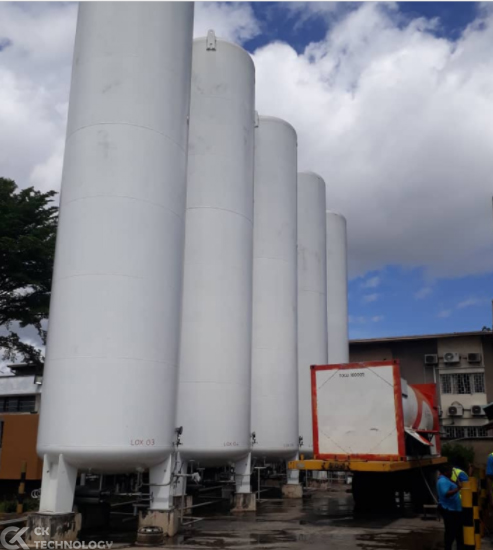
The cryogenic storage tank is a vertical or horizontal double-layer vacuum insulated storage tank for storing liquid oxygen, nitrogen, argon, carbon dioxide and other media. The material of the inner tank is austenitic stainless steel. The material of the outer container is Q235-B, Q245R or 345R according to the Chinese regulations in different user regions. The interlayer of the inner and outer containers is filled with insulating material perlite or aluminum foil, thermal insulation cotton and then pumped to vacuum.
Structure
Liquid natural gas must be stored in cryogenic storage tanks, which are usually composed of inner and outer tanks, filled with insulating materials.
Inner tank
Inner tank, also known as "film tank", is a liquid-tight and flexible inner container made of thin low-temperature steel plate. It has to pass the hydraulic head to the insulation. The material used as the film must have the characteristics of not embrittlement at low temperature, and have sufficient toughness and good processability. Usually nickel steel, stainless steel or aluminum alloys are used.
Heat insulation
While transferring the hydraulic head to the outer tank, the thermal insulation layer also plays the role of reducing the amount of vaporization, reducing the temperature difference between the inner and outer walls of the tank, and reducing the temperature difference stress generated by it. In addition, it also has the function of fixing the "film". Therefore, the thermal conductivity of the heat insulating layer is required to be low and to have sufficient strength. Materials that can meet these conditions include rigid foam urethane, foam glass, perlite, and rigid foam phenolic resin. In order to improve the thermal insulation performance and economical efficiency of the thermal insulation material, a thermal insulation method in which thermal insulation materials such as powder, fiber, and plate are mixed and used can be adopted.
After the liquefied natural gas is injected into the tank, the inner tank wall will shrink; on the contrary, after the liquefied natural gas is completely discharged, the temperature in the tank will gradually rise, and the inner tank wall will expand accordingly. The powdery insulating material filled in the middle of the inner and outer tanks becomes tight due to the repeated expansion and contraction of the inner tank wall. Therefore, it is necessary to lay a layer of thermal insulation layer with strong elasticity near the inner tank.
Outer tank (also known as tank body)
The outer tank is the shell that can withstand various loads, and it must have sufficient strength. According to the different materials used, it can be divided into the following types: frozen soil wall, steel wall, reinforced concrete wall and prestressed concrete wall.
- Permafrost wall. The permafrost wall and the thermal insulation cover form an airtight closed space as an outer tank, also known as a pit storage cavity. During construction, cooling pipes are used to freeze the soil around the inner tank. After the pit storage hole is put into operation, the low-temperature liquid will keep the surrounding frozen state, and this permafrost layer will expand year by year, so the evaporation loss will also decrease year by year. A prerequisite for the construction of a pit reservoir is a high water table. In addition, the bottom of the pit reservoir should be the least permeable rock or clay layer.
- Steel wall (including alloy and aluminum). It is only suitable for the construction of above-ground low-temperature storage tanks for liquefied natural gas. The above-ground low-temperature storage tanks are different from ordinary normal temperature storage tanks. It must be considered that the ground under the tank will bulge due to the freezing and expansion of the soil, so that the storage tank is in danger of damage. Therefore, measures must be taken to prevent the ground soil from freezing. Generally, above-ground storage tanks can be divided into two types: floor-mounted and overhead. Floor-standing bottoms are insulated with perlite concrete, hot air or hot water is passed through pre-buried pipes, or electric heaters are preset inside the foundation to prevent the soil from freezing. The overhead type is to use the column to support the tank chassis to separate it from the ground, keep the air between the storage tank and the ground unobstructed, prevent the liquefied natural gas from absorbing a lot of heat on the ground, and prevent the soil from freezing.
- Reinforced concrete walls and prestressed concrete walls. These two kinds of outer walls are the main materials of the underground tank shell and have the following advantages:
- Reinforced concrete and prestressed concrete are good low temperature materials, even if the membrane is damaged, the contact of the low temperature storage liquid with the prestressed concrete wall will not damage the outer wall;
- Good durability, not corroded by groundwater, not brittle;
- It has good liquid tightness and good shock resistance.
Foundation
There is no uniform standard for the design definition of the cryogenic storage tank itself. Compared with the UK's technical standards in this regard, it is more systematic and comprehensive. Its standard "Flat-bottom vertical cylindrical low-temperature storage tank application" defines low-temperature tanks as three types of tanks, including single-container tanks, double-container tanks and full-container tanks, according to different process requirements and medium storage methods. Single-container tanks are generally composed of a steel inner tank and an insulating outer shell, while double-container tanks and full-container tanks are made of a steel inner tank and a steel or concrete (usually prestressed concrete) It consists of an outer tank, and the thermal insulation is set between the inner and outer tank walls, and the double-capacity tank is mostly used.
When designing a low-temperature tank, due to the conduction of the low-temperature medium in the tank, the foundation soil is prone to freeze swell and cause the soil to bulge, thereby causing foundation damage. Therefore, in order to eliminate this disadvantage, in addition to the tank bottom and the foundation bottom In addition to the insulation measures between the surfaces, anti-freezing measures must also be taken for the tank foundation. There are two common methods. One is to use an electric or other heating system in the foundation bottom plate, that is, to make a raft-type foundation with a circulating heating system. The other is to use the base plate to be overhead, and the air layer formed by the overhead is used to separate the base plate from the foundation soil. The former is generally not used due to the high cost of the heating system. In most of the low-temperature tanks introduced and constructed in China, the form of overhead raft foundation is generally adopted. The net height of the overhead layer is generally determined according to the process piping and equipment layout requirements, but also needs to be determined after a certain temperature conduction calculation according to the temperature of the storage medium in the tank. Overhead raft foundation can be divided into single raft (cap) and double raft (cap) overhead. In the case of good geological conditions, the double raft foundation can generally be used; but due to low temperature storage. The requirements for the foundation settlement of the tank are relatively high. In most cases, especially on soft soil foundations with poor geological conditions, single raft (cap) pile foundations are mostly used, and sometimes double rafts (caps) are used.