
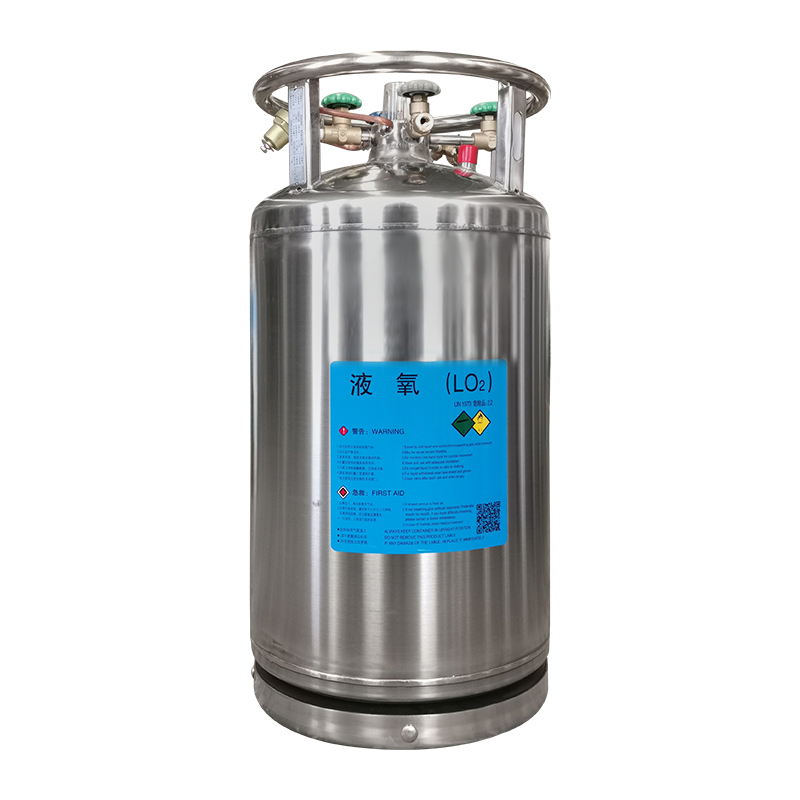
Dewars are also called thermos flasks, which are ideal containers and tools for storing liquie gas, low temperature research and crystal element protection. The modem Dewar flask was invented by the Scottish physicist and chemist Sir James Dewar.
The structure and functions of each part of dewar flasks are as follows:
1. Outer vessel: In addition to protecting the inner barrel, it also forms a vacuum inter-layer with the inner barrel to prevent the insutruction of heat outside the bottle and reduce the natural vaporization of cryogenic liquid in the dewar bottles;
2. Inner vessel: store cryogenic liquid;
3. Vaporizer: Through the heat exchange with the inner wall of the outher barrel, it can convert the liquid gas in the bottle into gaseous state;
4. Liquid valve: control the Dewar to fill or discharge liquid from the bottle;
5. Safety Valve: When the pressure of the vessel is greater than the maximum working pressure, it will automatically relieve the pressure, and its take-off pressure will be slightly greater than the maximum working pressure;
6. Drain Valve: When the Dewar container is filled with liquid, use this valve to discharge the gas in the gas phase space in the bottle to reduce the pressure in the bottle to fill the liquid quickly and smoothly. Another function is that when the pressure in the Dewar bottle exceeds the maximum working pressure during storage or other conditions, this valve can be used to manually discharge the gas in the bottle to reduce the pressure in the bottle;
7. Pressure gauge: indicates the pressure of the inner liquid oxygen cylinder.
8. Booster valve: After this valve is opened, the liquid in the bottle will exchange heat with the outer cylinder wall through the booster coil, vaporize into gas, enter the gas phase space on the upper part of the inner cylinder wall, and make the cylinder build up a certain driving pressure (internal pressure) to drive the cryogenic liquid in the bottle to make it flow;
9. Use valve: It is used to open the pipeline path between the liquid vaporization circuit of the Dewar bottle and the gas inlet of the user. This valve can also be used to control the gas flow rate;
10. Liquid level gauge: It is a more intuitive indication of the level of liquid like Liquid Nitrogen Cylinder in the container, and the installation position shoud be convenient for the operator to observe and maintain.
