
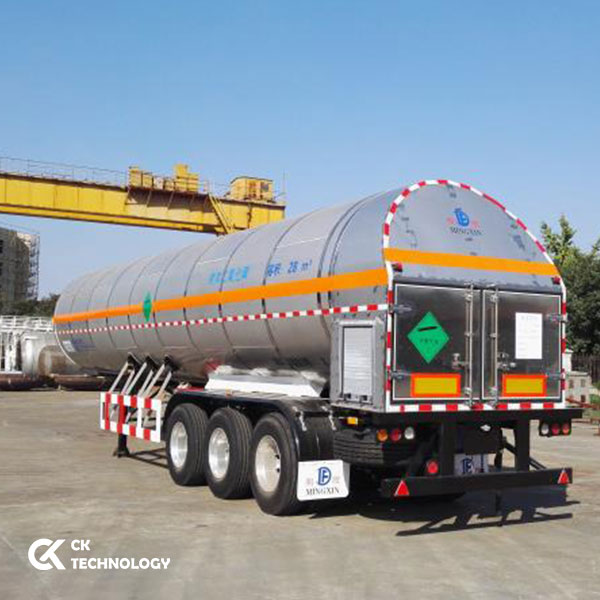
In June, the fertilizer operation department of PetroChina Daqing Petrochemical Company (hereinafter referred to as Daqing Petrochemical) was bustling with activity. Tank trucks line up one by one, and a continuous stream of liquid carbon dioxide is filled into the tanks. The destination of the tanker is very clear - Daqing Oil Field, 120 kilometers away, is the "new battlefield" of carbon dioxide. They will be injected underground as oil displacement agents to drive the reservoir to produce "green" crude oil.
"On May 15, the 400000 t/a high concentration carbon dioxide recovery project of Daqing Petrochemical was fully completed, which is the first carbon dioxide capture project in the refining chemical industry and new materials sector of CNPC." Lv Yinda, director of the fertilizer operation
department of Daqing Petrochemical, told reporters in Science and Technology Daily that when the project is completed and put into operation, 400000 tons of carbon dioxide can be directly captured every year, creating more than 23 million yuan of benefits, and achieving both ecological and economic benefits.
Utilizing Carbon Dioxide to Improve the Final Recovery Factor of Oilfield Oil Wells.
LCO2 recovery plant,LCO2 gas equipment, liquid storage, gas storage, cryogenic storage tank, dry ice maker, liquid nitrogen fertilizer plant, LCO2 generating plant, semi-trailer tank
Capture carbon dioxide, where does the carbon source come from? The answer is the "Fertilizer Operation Department" of Daqing Petrochemical.
The current Daqing Petrochemical Fertilizer Operation Department, formerly known as "Daqing Petrochemical Fertilizer Plant", was one of the 13 large-scale fertilizer production enterprises approved by the Central Committee of the Communist Party of China and the State Council in 1973 and one of the first batch of technology introduced nationwide. It was completed and put into operation on September 13, 1976.
"The devices and processes of the fertilizer plant came from abroad, which made great contributions to the country's fertilizer industry and agricultural production." Lv Yinda told the Science and Technology Daily that in the 1970s, Daqing Petrochemical introduced a synthetic ammonia
plant from Kellogg Company in the United States. After the expansion and reconstruction in 2005, the annual output of synthetic ammonia was 450000 tons, and the annual output of by-product carbon dioxide was 640000 tons; The carbon dioxide stripping urea production process technology introduced from Stamicarbon Company in the Netherlands has achieved an annual urea production capacity of 760000 tons.
However, with the adjustment of the national industrial structure, in 2015, the former Ministry of Agriculture promoted the strategic policy of reducing fertilizer usage and improving efficiency, proposing the goal of "zero growth in fertilizer usage by 2020". In response to the requirements of the situation, Daqing Petrochemical has optimized its product structure, increased sales of liquid ammonia products, and reduced urea production.
Due to the reduction in urea production, a large amount of raw material carbon dioxide has been released, "said Lv Yinda. According to statistics, from 2017 to 2021, the annual carbon dioxide emissions from the synthetic ammonia plant reached 300000 to 450000 tons per year.
Can the discarded carbon dioxide be utilized as a resource? The carbon capture, utilization, and storage (CCUS) technology provides the answer.
Daqing Petrochemical utilizes the carbon dioxide compressor in the old urea plant to install a dryer at the outlet of the second stage of the
carbon dioxide compressor. The dried and dehydrated carbon dioxide is pressurized to 14.7 MPa through the third and fourth stages of the compressor, converting the by-products of the synthetic ammonia plant into high-purity carbon dioxide with a volume ratio greater than 99%.
Lu Peng, senior director of project management of Daqing Petrochemical Technology and Planning Development Office, told the reporter of Science and Technology Daily that carbon dioxide, after drying, can be used as oil displacement agent for oil fields, which can not only reduce carbon emissions, but also improve the ultimate recovery factor of existing oil wells, with an annual profit of more than 23 million yuan.
At present, the carbon capture, utilization and storage industry in Daqing Oil Field is booming in both supply and demand. The "14th Five Year Plan" of Daqing Oil Field proposed that the CCUS oil production capacity of 600000 tons and carbon dioxide storage capacity of 1.43 million tons should be achieved in Aonan Oilfield by 2025.
Conducting technical research to control the risk of carbon dioxide transportation-semi-trailer tank and tanker
Adjacent to Daqing Oil Field has become the unique advantage of Daqing Petrochemical's CCUS project layout. On the one hand, as a major consumer of carbon dioxide, oil fields can provide an application market for captured carbon; On the other hand, captured carbon dioxide can be
utilized without long-distance transportation, and development costs will be significantly reduced.
Carbon dioxide has the characteristic of low critical parameters and is extremely prone to phase changes, "Lu Peng said. Existing pipeline transportation types can be divided into three types: gas, liquid, and supercritical. However, transportation pipelines and equipment need to be
selected based on factors such as the phase state of carbon dioxide and the characteristics of different transportation methods.
Therefore, China is conducting large-scale research on carbon dioxide pipeline transportation technology to achieve carbon dioxide transportation and risk control under different scenarios.
Lu Peng told Science and Technology Daily that in order to find out the boundary conditions for Pipeline transportation of carbon dioxide, Daqing Oil Field Petrochemical Company and Daqing Petrochemical Company jointly studied and demonstrated that through pipeline transportation simulation analysis, when the pressure of Supercritical carbon dioxide reaches 14.7 MPa, there is no need to increase the pressure throughout the pipeline transportation, and the pressure at the end of the pipeline can be guaranteed to be above 9 MPa.
The pipeline technology scheme designed by Daqing Petrochemical ensures that the entire pipeline is in a stable and efficient supercritical/dense
phase transportation state of carbon dioxide, and the residual pressure can also serve as the inlet pressure for the oil field carbon dioxide injection facility, achieving integrated optimization of upstream and downstream, with reasonable technology and economy.
At present, the carbon dioxide supercritical pipeline connecting Daqing Oil Field and Daqing Petrochemical is under construction. Before the completion of the pipeline construction, the captured carbon dioxide will be transported by liquid tankers/ISO tank.