
Recently, the Qingdao Marine Geological Carbon Sequestration Engineering Research Center and Qingdao Marine Geological Carbon Sequestration Key Laboratory were unveiled in Qingdao. This is the first engineering research center and key laboratory in China that focuses mainly on marine geological carbon sequestration.
What is marine geological carbon sequestration? How to make carbon dioxide settle in the seabed? The reporter interviewed Chen Jianwen, the leading person in charge of evaluating the potential of carbon dioxide geological storage in China's marine areas, a researcher at Qingdao Institute of Marine Geology, and the director of Qingdao Marine Geological Carbon Storage Engineering Research Center and Key Laboratory, to reveal the secrets of underwater carbon storage.
Chen Jianwen, the leading person in charge of evaluating the potential of carbon dioxide geological storage in China's marine areas, a researcher at Qingdao Institute of Marine Geology, and the director of Qingdao Marine Geological Carbon Storage Engineering Research Center and Key Laboratory
China's marine carbon sequestration potential reaches 2.58 trillion tons
Chen Jianwen introduced that marine geological carbon sequestration, in layman's terms, refers to capturing carbon dioxide generated during industrial production, energy utilization, and other processes, compressing and injecting it into the seabed, and permanently storing it on the seabed.
Marine geological carbon sequestration has become a key development direction for global CCUS due to its high potential, high safety, and low environmental risks, "said Chen Jianwen.
Coastal areas are industrial agglomeration areas and concentrated carbon dioxide emission areas in China, accounting for 47% of the country's total carbon emissions. Due to the unique geological conditions and dense population of coastal provinces and cities, it is difficult to find suitable carbon sequestration sites on land. The numerous sedimentary basins developed in China's marine areas provide favorable conditions for the geological storage of carbon dioxide.
Last year, the China Geological Survey of the Ministry of Natural Resources released for the first time the evaluation results of the geological storage potential of carbon dioxide in China's marine areas. This evaluation result was led by the Qingdao Institute of Marine Geology of the China Geological Survey.
This is the first time that China has conducted a systematic and comprehensive evaluation of the carbon dioxide potential in Chinese waters using measured data, and has also established a geological carbon sequestration potential and suitability evaluation technology system suitable for the geological conditions of Chinese waters. The system has evaluated the three levels of geological carbon sequestration potential in Chinese waters, and basically identified the resource base of geological carbon sequestration in Chinese waters. "Chen Jianwen introduced that the evaluation results showed that the carbon sequestration potential in Chinese waters reached 2.58 trillion tons. This provides a huge space for the underwater storage of carbon dioxide in China, which is of great significance for achieving carbon neutrality in China and also provides an important path for carbon neutrality in coastal provinces and cities
Transport of carbon dioxide in supercritical state
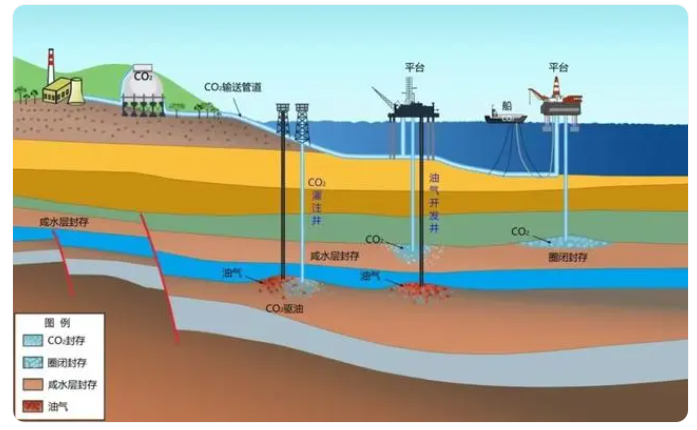
How to make carbon dioxide settle in the seabed? Chen Jianwen gave a layman's interpretation to the reporter. Firstly, we need to find a place on the seabed that can store carbon dioxide. Carbon dioxide is mainly stored in sedimentary basins on the seabed, and its storage media include saline water layers, unmineable coal seams, etc. Among them, the storage capacity of saline water layers accounts for more than 90% of the underground storage capacity of carbon dioxide. Meanwhile, the relative aquitards between saline aquifers have good sealing conditions and are the main areas for carbon dioxide sequestration.
Example diagram of underwater carbon sequestration
Once the location of the seabed is chosen, carbon dioxide from the land can be transported there. Firstly, the captured carbon dioxide needs to be compressed by machines into a supercritical state with a density close to liquid and a viscosity close to gas. This reduces the volume and facilitates transportation
Then the compressed carbon dioxide is transported by transport vehicles or pipelines to the offshore operation platform, where it is stored and gradually injected into the found saline layer through drilling.
Chen Jianwen introduced that the infusion speed should not be too fast. Supercritical carbon dioxide has a certain degree of fluidity, but its infiltration in underwater rock layers still requires time, so it needs to flow slowly in the rock layers.
It is understood that at present, China has a demonstration project of seabed carbon sequestration - the carbon sequestration demonstration project of Enping 15-1 Oilfield in the the Pearl River Mouth Basin. Its launch marks that China has initially formed a complete set of technology and equipment system for offshore carbon dioxide injection, sequestration and monitoring. Chen Jianwen introduced that the demonstration project has been officially injected since June last year, with an annual carbon dioxide storage capacity of 300000 tons and a maximum daily injection volume of 200000 cubic meters.
In fact, internationally, there have been countries that have implemented carbon dioxide sequestration, such as Norway and Denmark, which are conducting carbon sequestration under the North Sea seabed. According to reports, the Slepner project in Norway has accumulated over 20 million tons of carbon dioxide since its injection in 1996, with an annual storage capacity of 1 million tons. The project is still undergoing continuous injection.
Expected to launch the 10 million ton marine geological carbon sequestration project in the South Yellow Sea
Chen Jianwen introduced that globally, the development of marine geological carbon sequestration can be roughly divided into four stages, including theoretical research stage, potential evaluation stage, engineering demonstration stage, and commercial application stage. China is currently in the early stage of potential evaluation and exploration of engineering demonstration, and we still have a long way to go in achieving underwater carbon sequestration in the future.
Last year, we selected four zones in the South Yellow Sea, and this year we will select sites based on these four zones to lay a foundation for the future construction of offshore carbon sequestration demonstration projects. "Chen Jianwen said," In the future, relying on two marine geological carbon sequestration technology innovation platforms, we will focus on building a full chain technology and corresponding standard system for marine geological carbon sequestration, and research and develop supporting equipment and instruments. We hope that under the framework of the Qingdao Municipal Government's overall coordination and the city's dual carbon industry alliance, the South Yellow Sea 10 million ton marine geological carbon sequestration project will be launched in 2027, and the project will be implemented by 2030 to promote the green, low-carbon and high-quality development of Qingdao
Air Separation Plant/Nitrous oxide plant/CO2 recovery plant/Hydrogen plant/Acetylene Plant/Mobile Tank/ISO Tank Container/Cryogenic Storage Tank/LPG Storage Tank/Cryogenic Pump/Micro Bulk Tank Solutions/Cryogenic Semi Trailer Transport Tanker/LPG Semi Trailer Tanker/Dewar Flask/Vaporizer/Cylinders/Dry ice making machine/Calcium Carbide