
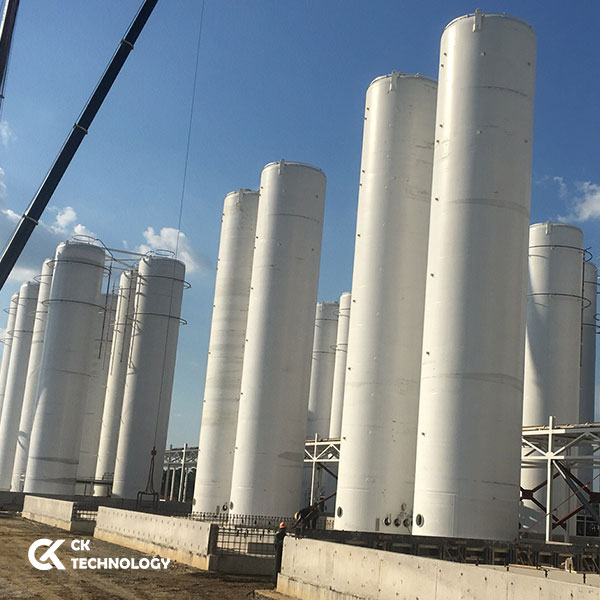
Liquid natural gas must be stored in cryogenic storage tanks. LNG cryogenic storage tanks are usually composed of an inner tank and an outer tank, filled with thermal insulation materials.
The inner tank of the cryogenic storage tank, also known as the "film tank", is a liquid-tight and flexible LNG cryogenic storage tank inner container made of thin cryogenic steel plates. The inner vessel of cryogenic storage tanks must pass the hydraulic head to the insulation. The material used as the film in the cryogenic storage tank must have the characteristics of not embrittlement at low temperature, and have sufficient toughness and good processability. The material of the inner container of cryogenic storage tank is usually nickel steel, stainless steel or aluminum alloy.
Heat insulation
The thermal insulation layer of the LNG cryogenic storage tank not only transmits the hydraulic head to the outer tank, but also reduces the amount of gasification, reduces the temperature difference between the inner and outer walls of the tank, and relieves the resulting temperature difference stress. The thermal layer also has the function of fixing the "film". Therefore, the thermal conductivity of the heat insulating layer is required to be low and to have sufficient strength. Materials for cryogenic storage tanks that can meet these conditions include rigid foam urethane, foam glass, perlite, and rigid foam phenolic resin. In order to improve the thermal insulation performance and economy of the thermal insulation material, the low temperature storage tank can adopt a thermal insulation method that is mixed with thermal insulation materials such as powder, fiber, and plate.
After the liquefied natural gas is injected into the LNG cryogenic storage tank, the inner tank wall will shrink; on the contrary, after the liquefied natural gas is completely discharged, the temperature in the cryogenic storage tank will gradually rise, and the inner tank wall of the cryogenic storage tank will expand accordingly. The powdery insulating material filled between the inner and outer tanks in the low temperature storage tank becomes tight due to the repeated expansion and contraction of the inner tank wall. Therefore, a layer of thermal insulation layer with strong flexibility must be laid near the inner tank of the low temperature storage tank. The buffering effect ensures the safe operation of the LNG cryogenic storage tank.