
The traditional gas supply modes of professional gas companies include bottled gas mode, liquid gas mode, on-site gas production mode and pipeline gas supply mode. Among them, bottled gas mode and liquid gas mode can be collectively referred to as retail gas mode, and on-site gas production mode and pipeline gas supply mode can be collectively referred to as bulk gas mode. In addition, a more unique circular economy-type industrial park cluster supply model was developed, which has enriched the industry with new development ideas and models.
Companies in the industry combine various gas supply methods and generally choose the most economical and effective gas supply method according to their own situation, customer industry characteristics, demand, relative geographic location, plant size, etc., but there is a certain degree of difference between the various gas supply methods. The subdivision and combination of crossover.
It is worth noting that the downstream of the liquid gas mode mainly includes bottled gas filling stations and end customers in various industries. Liquid gas is an important source of profit for large and medium-sized professional gas production enterprises. For example, the liquid gas business of Linde Praxair Group, Air Liquide, and Air Products all accounted for more than 30% of revenue, and Air Liquide reached 54%. The domestic industrial gas industry started late and is still in the development stage. For example, in Hangyang, Yingde Gas's liquid gas revenue accounts for only 8%-10%, and there is still a lot of room for development.
|
Chart 8: Comparison of mainstream industrial gas supply modes |
|||
|
Main mode |
Air supply method |
Sales method |
Participating companies |
|
Bottled gas--with Seamless Steel Gas Cylinder |
For gas users with small demand or mobility needs, gas cylinders are an extremely practical construction schedule method. Industrial gas companies can use individual gas cylinders, dewars, or gas cylinders with different solvents for gas supply, and tanks for gas supply according to customer needs. |
Because the bottled gas model is restricted by transportation costs, the sales radius generally does not exceed 100 kilometers, so the regional characteristics of the bottled gas market are obvious. Affected by the transportation radius of bottled gas, the supply market is fragmented. |
Regional competitors are mainly a large number of gas filling stations scattered in various places. These filling stations mainly provide liquid gas gasification and filling functions. They do not produce gas themselves and mostly purchase from upstream. |
|
Liquid gas |
For customers with medium gas consumption, Industrial Gas Company can provide low-temperature liquid storage tanks to supply gas at the customer's site, and use tank trucks for transportation supplements, and meet the needs of different industries through liquid gas supply systems of different scales and flows. The liquid gas comes from the company's own liquid production base or the surplus production capacity of existing large-scale gas/industrial gas plant supply projects. |
It is suitable for customers who are far away, use a lot of gas, or do not have the conditions for pipeline gas supply and on-site gas production. The sales radius of liquid gas generally does not exceed 300 kilometers, and it also has certain regional characteristics. |
Companies engaged in liquid gas production mainly include traditional steel and chemical companies that build their own air separation equipment, foreign giants, and domestic privately-owned professional gas production companies. The initial investment in the liquid gas mode is relatively large, the entry barrier is high, and the market concentration is higher than that of bottled gas. |
|
On-site gas production |
On-site gas production is generally a one-to-one customized solution. Or a small and medium-sized on-site gas production device for customers' demand for continuous and reliable gas supply that changes at any time; or a 10,000-ton large and highly integrated system for ultra-large-scale customers. |
On-site gas production mode is not familiar with transportation restrictions, and there is no clear sales radius. |
Companies engaged in on-site gas production are companies with certain capital and technical strength in the industry, mainly foreign giants, domestic-funded professional gas production companies and some air separation equipmentmanufacturers. Foreign-invested gases such as Air Liquideand Linde Gas have entered the Chinese market, and their strong financial strength and rich project operation experience quickly occupied the domestic large-scale gas production market with absolute advantages. |
|
Pipeline supply |
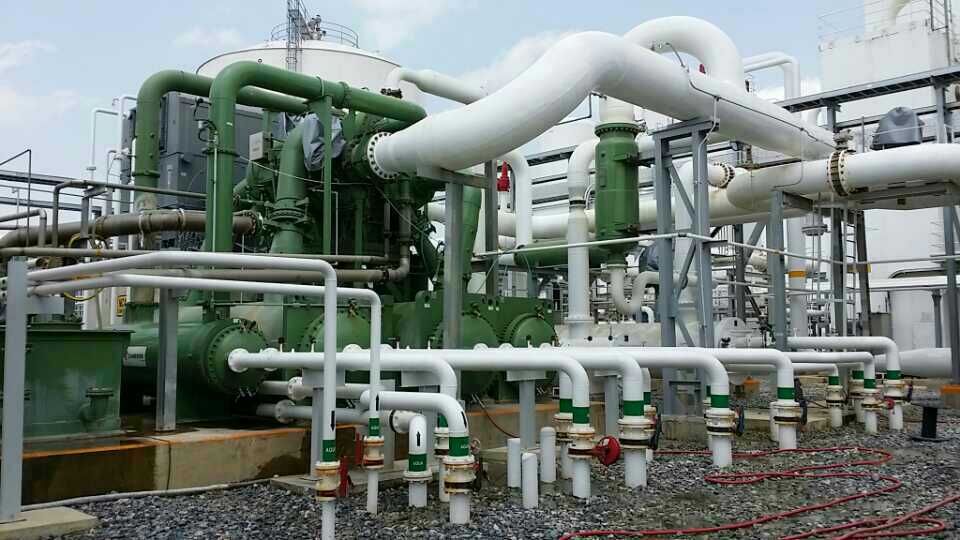
For industrial gas users with large gas consumption and group customers concentrated in industrial areas, professional gas production companies can transport the gas produced in nearby production bases to industrial parks with related needs through pipelines to achieve simultaneous gas supply to multiple customers. |
The sales radius of pipeline transportation generally depends on the geographical location of the park. Generally speaking, the industrial park where the production base and users are concentrated no more than 20 kilometers, or the on-site gas production equipment is directly invested in the park for many gas users. |
The main participants in the pipeline gas supply model are mostly multinational companies and strong domestic professional gas companies. Among local companies, Yingde Gas is the larger pipeline gas supplier. |