
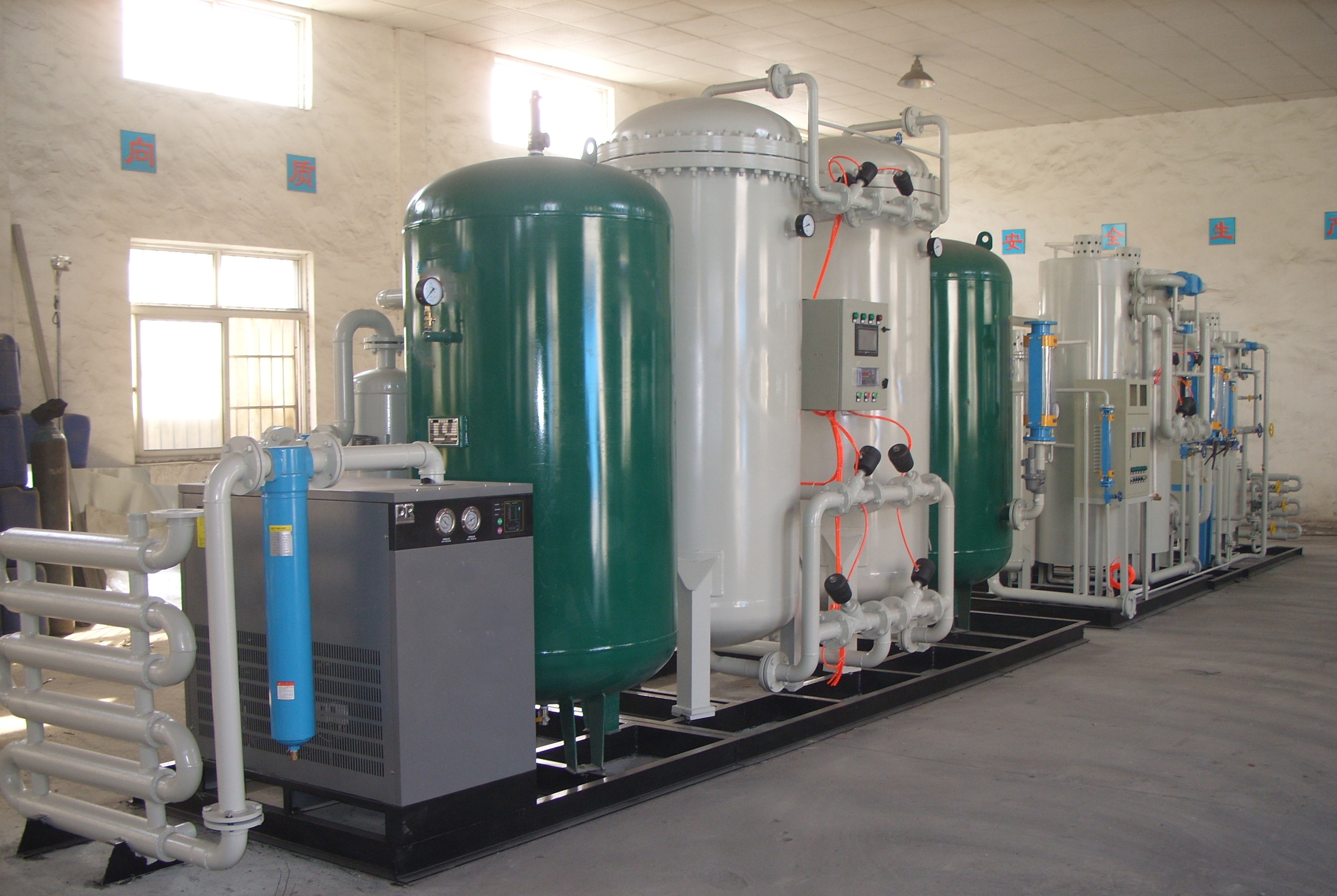
Nitrogen, with the chemical formula N2, is usually a colorless, odorless gas, and generally less dense than air. Nitrogen accounts for 78.08% (volume fraction) of the total atmosphere and is one of the main components of air. At standard atmospheric pressure, nitrogen gas turns into a colorless liquid when cooled to -195.8°C, and liquid nitrogen turns into a snow-like solid when cooled to -209.8°C. The chemical nature of nitrogen is inactive, and it is difficult to react with other substances at room temperature, so it is often used to make preservatives. However, under high temperature and high energy conditions, it can undergo chemical changes with certain substances to produce new substances useful to human beings.
So what are the production methods of nitrogen?
Nitrogen production method 1: Molecular sieve air separation to produce nitrogen
Molecular sieve air separation nitrogen production takes air as raw material, carbon molecular sieve as adsorbent, using the principle of pressure swing adsorption, using carbon molecular sieve to selectively adsorb oxygen and nitrogen to separate nitrogen and oxygen, commonly known as PSA (Pressure Swing Adsorption) ) to produce nitrogen. This method is a new nitrogen production technology developed rapidly in the 1970s. Compared with the traditional nitrogen production method, it has the advantages of simple process flow, high degree of automation, fast gas production (15-30 minutes), low energy consumption, product purity can be adjusted according to user needs in a large range, convenient operation and maintenance, and operation. Due to the characteristics of low cost and strong device adaptability, it is quite competitive in nitrogen production equipment below 1000Nm3/h, and is increasingly welcomed by medium and small nitrogen users. PSA nitrogen production has become the first choice for medium and small nitrogen users. method.
Nitrogen production method 2: Cryogenic air separation to produce nitrogen
Cryogenic air separation nitrogen production is a traditional method of nitrogen production (nitrogen) with a history of nearly 90 years. It uses air as raw material, after compression, purification, and then use heat exchange to liquefy the air into liquid air. Liquid air is mainly a mixture of liquid oxygen and liquid nitrogen. Using the different boiling points of liquid oxygen and liquid nitrogen (under 1 atmosphere, the boiling point of the former is -183 °C, and the latter is -196 °C), through the rectification of liquid air , separate them to obtain nitrogen. Cryogenic air separation nitrogen production equipment is complex, covers a large area, has high infrastructure costs, large one-time investment in equipment, high operating costs, slow gas production (12-24h), high installation requirements and long cycle times. Comprehensive equipment, installation and infrastructure factors, equipment below 3500Nm3/h, the investment scale of the PSA unit of the same specification is 20% to 50% lower than that of the cryogenic air separation unit. Cryogenic air separation nitrogen generator is suitable for large-scale industrial nitrogen production, but medium and small-scale nitrogen production is uneconomical.
Nitrogen production method 3: Nitrogen production by membrane air separation
Membrane air separation nitrogen production is another new type of nitrogen production technology that developed rapidly abroad in the 1980s. The basic principle of nitrogen production by membrane air separation is to use air as raw material. Under certain pressure conditions, oxygen and nitrogen are used to separate oxygen and nitrogen with different permeation rates in the membrane. Compared with other nitrogen making equipment, it has the advantages of simpler structure, smaller volume, no switching valve, less maintenance, faster gas production (≤3 minutes), convenient capacity expansion, etc. It is especially suitable for nitrogen purity ≤ 98% of medium and small nitrogen users have the best feature-price ratio. When the nitrogen purity is above 98%, its price is more than 15% higher than that of the PSA nitrogen generator of the same specification. It can be seen from the above that what gas supply method and gas supply technology are used by MnZn ferrite production enterprises must conduct technical and economic demonstrations according to the situation of the enterprise, and select the best gas supply scheme.