

Ozone, an allotrope of oxygen, with a chemical formula of O3 and a formula weight of 47.998, is a light blue gas with a fishy smell. Ozone has strong oxidizing properties and is a stronger oxidant than oxygen. It can oxidize at lower temperatures. For example, it can oxidize silver to silver peroxide, oxidize lead sulfide to lead sulfate, and react with potassium iodide to generate iodine. Turpentine, gas, etc. can spontaneously combust in ozone. Ozone is a powerful bleach in the presence of water. It is also easy to generate ozone oxides with unsaturated organic compounds at low temperatures. Used as strong oxidant, bleach, fur deodorant, air purifier, disinfectant, disinfection and deodorization of drinking water.
Advantages of ozone disinfection
(1) Disinfection has no dead ends, high sterilization efficiency, and deodorization. During disinfection, the ozone generator generates a certain amount of ozone. In a relatively closed environment, it diffuses evenly and has good permeability, which overcomes the problem of disinfection dead corners existing in ultraviolet sterilization, and achieves all-round, fast and efficient disinfection and sterilization purposes. In addition, because of its wide bactericidal spectrum, it can not only kill bacterial propagules, spores, viruses, fungi and protozoa and other microorganisms, but also destroy botulinum toxin and rickettsia, etc. Strong in addition to mildew, fishy, smelly and other odors.
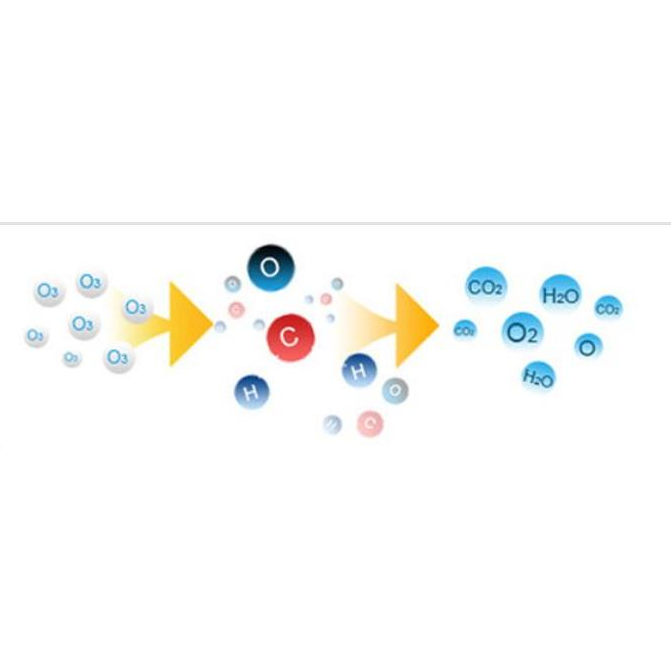
(2) No residue, no pollution. Ozone is produced by the use of oxygen in the air. In the process of disinfection and oxidation, the excess oxygen atoms are combined into molecular oxygen after 30 minutes, and there is no residual substance, which solves the problem of secondary pollution remaining in the disinfection of disinfectants, and eliminates the need for Clean again after disinfection.
Disinfection
Ozone is a strong oxidant, its molecule is extremely unstable, it can decompose and produce monoatomic oxygen (O) and hydroxyl (OH) with strong oxidizing ability. The internal structure of microorganisms such as viruses has a strong killing effect on various pathogenic microorganisms. The sterilization process is a biochemical oxidation reaction. Its role is mainly achieved in the following three forms: (1) ozone can oxidize the enzymes needed to decompose glucose inside bacteria, so that bacteria inactivate and die; (2) act on nuclear substances in bacterial cells, such as purines in nucleic acids and pyrimidine, destroy their organelles, DNA and RNA, destroy the metabolism of bacteria, and lead to bacterial death; (3) ozone reacts with bacterial cell wall lipids double-stranded, penetrates through the cell membrane tissue, invades the cell, and acts on the outer membrane. Lipoproteins and internal lipopolysaccharides cause the bacteria to undergo permeability distortion and dissolve and die; [7] (4) Ozone acts on the 4 polypeptide chains of the capsid protein of the virus, and damages the RNA and destroys its formation. protein. After the phage is oxidized by ozone, its epidermis is broken into many fragments, from which many ribonucleic acid is released, which interferes with its adsorption to the deposit.
The role of ozone is mainly concentrated in five aspects: anti-inflammatory and anti-infection, relieving pain and labor, oxidizing cholesterol, improving immunity, and supplying oxygen to ischemic tissue. However, because the molecular structure of ozone is a special molecule composed of three oxygen atoms, although it has strong oxidizing properties, it is also very unstable. Under normal temperature and pressure, it will automatically reduce to oxygen after 20 minutes. Therefore, the ozone used clinically is made from existing products, and is usually produced by ozone generators. Its generation principle can be obtained by high-voltage discharge, corona discharge, electrochemistry, photochemistry, atomic radiation and other methods. A process of body transformation. After the ozone is made, it can be dissolved in sterilized water, blood, body fluids, or directly acted on tissues as needed to achieve different therapeutic purposes.