
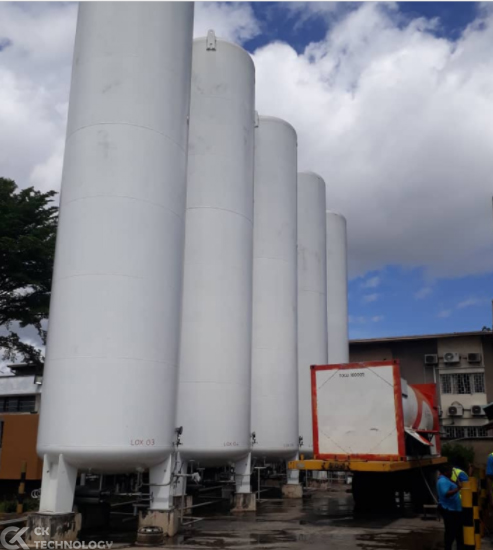
- The liquid oxygen storage tank is generally placed in a safe place near the air separation plant, away from fire sources, heat sources and combustibles.
- Powder vacuum insulation liquid oxygen storage tank, the inner cylinder is made of stainless steel with good low temperature performance, and the outer cylinder is made of carbon steel. Evaporation overpressure.
- Pearlescent sand insulation type liquid oxygen storage tank, the inner cylinder is made of high-strength alloy aluminum, the outer cylinder is made of carbon copper, the interlayer is filled with pearlescent sand insulation material of sufficient thickness, and the bottom layer is insulated with a certain thickness of foam glass bricks or slag wool to prevent Liquid oxygen violently evaporates over pressure. The foundation of the liquid oxygen storage tank should be waterproof and resistant to meet the requirements of low temperature conditions.
- The inner wall of the liquid oxygen storage tank should be degreased with carbon tetrachloride. Since the inner cylinder is made of stainless steel or high temperature alloy aluminum, argon arc welding is generally used.
- Both the inner and outer cylinders of the liquid oxygen storage tank shall be subjected to strength test and air tightness test.
- Overpressure of liquid oxygen storage tank is strictly prohibited.
- In order to reduce the cooling loss of the liquid oxygen storage tank and prevent overpressure due to violent evaporation, the powder vacuum insulation liquid oxygen storage tank must frequently monitor the vacuum degree and tank pressure of the interlayer, and use the method of vacuuming to improve if necessary. The vacuum of the interlayer. For powder (pearl sand) adiabatic liquid oxygen, the interlayer pearl sand should be full and full, and the pearl sand should be filled with dry nitrogen to improve the degree of thermal insulation.
- The liquid oxygen in the liquid oxygen storage tank is continuously evaporated, and the concentration of acetylene may increase, resulting in accumulation and precipitation. In order to prevent explosion, the liquid oxygen in the liquid oxygen storage tank should be used as much as possible while being charged, and it should be updated frequently to prevent the accumulation of acetylene. Analyze the acetylene content in the liquid oxygen once a week, and empty the liquid oxygen if it exceeds the standard.
- Prevent liquid oxygen from leaking, freezing facilities and freezing people.
- The liquid oxygen storage tank should maintain positive pressure to prevent the inhalation of moist air and cause freezing and blockage. Before the liquid oxygen storage tank is put into use, it should be brushed with dry nitrogen to remove moisture.
- Pressure gauges, vacuum gauges, liquid level gauges, alarm systems, safety valves, etc., must be regularly calibrated, requiring accuracy, sensitivity, and safety.
- Oxygen has magnetic inductance. Under the action of discharge, it is easy to form ozone with extremely high chemical activity, which is a kind of detonation excitation energy. Therefore, within a radius of 30m around the liquid oxygen storage tank, open flames or electric sparks are strictly prohibited, and explosion-proof electrical appliances must be used.