
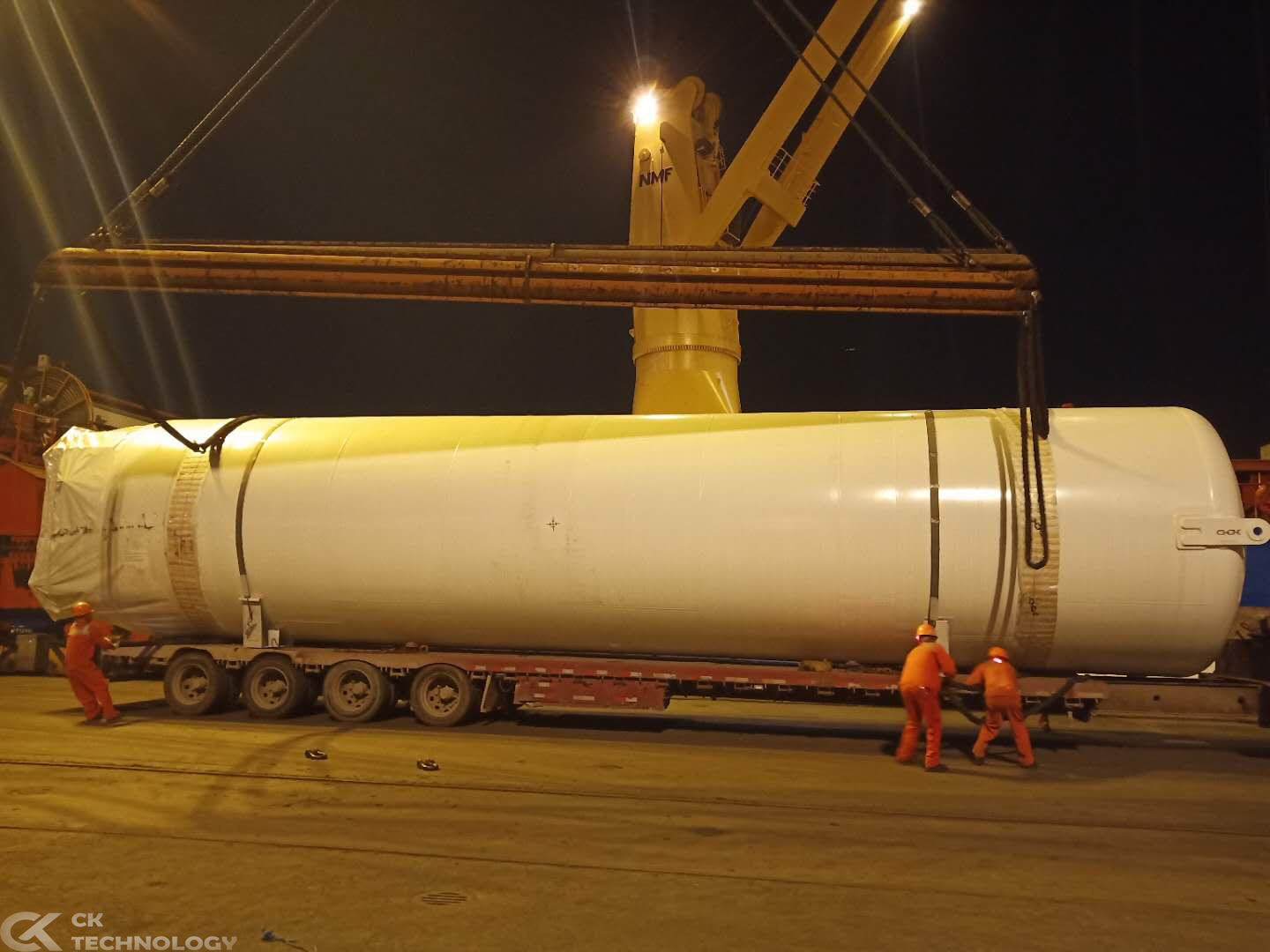
Cryogenic Storage Tank - Dewar
At present, there are three types of LNG cryogenic storage tanks commonly used at home and abroad: atmospheric storage, sub-tank under pressure storage and vacuum tank under pressure storage. Which storage method is used mainly depends on the size of the storage capacity.
- Vacuum tank
The vacuum tank is a double-layer metal tank, the inner tank is a low-temperature resistant stainless steel pressure vessel, the outer tank is made of carbon steel material, and the interlayer is filled with thermal insulation material and vacuumed. The vacuum tank is transported to the site as a whole after the pressure test is completed in the factory.
The total storage capacity of LNG storage tanks is less than 1000m³, and multiple vacuum tanks are generally used for centralized storage. At present, the maximum volume of a single tank of vacuum tanks used in China is 150m³. The process flow of the vacuum tank is relatively simple. Generally, a supercharger is used to pressurize the storage tank, and the material enters the gasifier by self-flow under pressure. Power equipment is not used, and the energy consumption is low. Therefore, small-scale LNG gasification stations at home and abroad basically all use vacuum. Tank form.
- Clustertank
The inner tank of cluster tank is a plurality of low-temperature resistant stainless steel pressure vessels, the outer tank is a large carbon steel container covering the multiple inner tanks, and the inner and outer tanks are also filled with thermal insulation materials with dry nitrogen gas to fill between interlayer. The inner tank of the cluster tank is manufactured in the factory and shipped to the site after pressure test, and the outer tank is installed on site.
For storage and distribution stations with a storage scale of 1000m³ to 5000m³, you can choose cluster tank or an atmospheric tank for storage according to the situation. Due to the transportation requirements of the inner tank, at present, a single tank in China can reach a maximum of 250m³, and the gasification process of the tank is adopted. The process is roughly the same as that of the vacuum tank. Since the interlayer needs to be vented with nitrogen, a liquid nitrogen device is added to the device.
- Atmospheric pressure tank
The structure of atmospheric pressure tanks includes bimetallic tanks, and the outer tanks use prestressed concrete structures; there are aboveground tanks, and underground tanks, and most of the tanks below 20,000m³ are bimetallic tanks.
The inner and outer tanks of the atmospheric tank are installed and manufactured on site, and the production cycle is long.
The operating pressure of the LNG cryogenic storage tank is 15KPa, the operating temperature is -162℃, and it is a flat-bottomed double-walled cylinder. The tank body is composed of inner and outer layers, and the two layers are thermal insulation structure, which is a cold insulation layer. The inner tank is used to store liquefied natural gas, while the outer shell protects and keeps cold. In order to reduce the introduction of external heat into the tank, the inner and outer tanks are designed to be separated and independent. The tank item is a self-supporting vault, and the inner tank item must have sufficient strength and stability to withstand the external pressure caused by the cold insulation material and the internal pressure generated by the internal gas.
The storage tank uses perlite as the cold-insulating material, and is filled with dry nitrogen to ensure the micro-positive pressure of the interlayer. The insulating material is isolated from the atmosphere, avoiding the influence of atmospheric pressure or temperature changes and the entry of wet air into the cold-insulating layer between the inner and outer tanks, increasing the service life of the cold insulation material and the use effect of the cold insulation material is effectively guaranteed and improved. In the design and manufacture of thermal insulation structures, attention must be paid to the use of moisture-proof measures.
Through technical and economic comparison, the one-time investment of the low-temperature storage tank solution is lower than that of the cluster tank solution, but the operating cost of the low-temperature atmospheric storage tank solution is much higher than that of the cluster tank solution.
Although the one-time investment of the low-temperature atmospheric storage tank scheme is low, there are the following problems in the scheme:
- Low temperature and atmospheric pressure storage tanks are more suitable for liquefaction plants and receiving terminals
Usually, low temperature and atmospheric pressure storage tanks are used in the liquefaction plant and the receiving terminal station. This is because the LNG storage tanks in the receiving terminal station have a large volume (the volume of a single tank is greater than 50,000 m³), which cannot be achieved by other forms of storage tanks. The liquid is transported by LNG tanker, and the storage tank on the LNG tanker is also in the form of low temperature and normal pressure, and the pressure changes little. Moreover, a BOG condensing device is installed in the receiving terminal, which can convert BOG into LNG.
Due to the liquefaction means in the liquefaction plant, the BOG generated during storage can be turned into regeneration gas for liquefaction, so the use of low-temperature atmospheric pressure storage tanks has little effect on the amount of BOG evaporation.
Since the LNG used in this station is all transported by the truck tanker, the LNG in the tanker is under pressure, and when it is unloaded into the low-temperature atmospheric tank, a large amount of gasification will occur, resulting in a large amount of BOG gas. Moreover, since BOG is atmospheric gas, the investment and operation cost of BOG compressor are high. The operating costs of LNG pumps also increased.
- The low temperature and atmospheric pressure storage tank system is complex
The low temperature atmospheric pressure storage tank needs to consider the overpressure of the storage tank and the evacuation (formation of negative pressure) of the storage tank, and needs to have air supply measures, so the storage tank should be equipped with multiple imported low temperature regulating valves, breathing valve, etc. The top of the storage tank should also be equipped with an automatic dry powder fire extinguishing system and a lifting device.
Since the general working pressure of the low-temperature atmospheric storage tank is 15KPa, in order to maintain this pressure, the pressure regulating valve of the storage tank needs to be opened frequently, and the BOG gas is recovered to the liquefaction section or burned by the torch in the station.
This station does not have this part of the facilities. If a low temperature and atmospheric pressure tank is used, only part of the BOG can be compressed to the pipe network for transportation, and the rest must be released, which will cause waste and pollute the environment. Or build a comparable BOG storage tank for BOG storage in the station, which will inevitably increase a large investment.
- The LNG pump needs to be set up, and the requirements for the LNG pump are high.
Since the liquid stored in the low-temperature atmospheric storage tank is not under pressure, in order to meet the net positive suction head of the LNG pump, the foundation (overhead foundation) of the storage tank should be improved. Moreover, in order to prevent cavitation, the liquid inlet pipe of the LNG pump should consider adopting a vacuum cooling pipe.
- The construction period is long, and maintenance is more difficult
The inner and outer tanks of the atmospheric tank are installed and manufactured on site, and the production cycle is long. If the storage tank fails, it needs to be completely shut down for maintenance.