
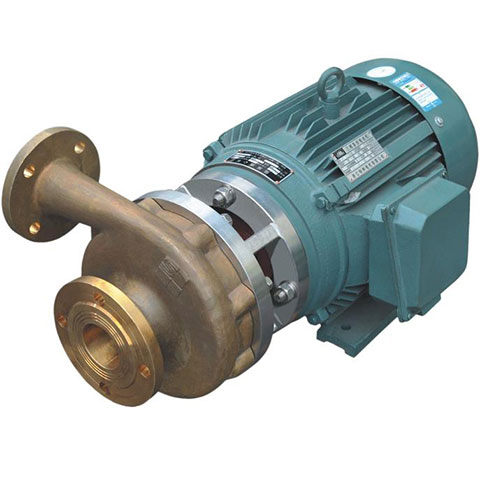
- What is the main working principle of a centrifugal pump?
The motor drives the impeller to rotate at a high speed, causing the liquid to generate centrifugal force. Due to the centrifugal force, the liquid is thrown into the side flow channel and discharged out of the pump, or into the next-stage impeller, so that the pressure at the impeller inlet is reduced, and the pressure acting on the suction liquid is formed. The pressure difference acts on the liquid suction pump. Due to the continuous rotation of the centrifugal pump, the liquid is continuously sucked or discharged.
- What are the functions of lubricating oil (grease)?
Lubrication cooling effect, flushing effect, sealing effect, vibration damping effect, protection effect, unloading effect.
- Which three stages of filtration should lubricating oil go through before use?
The first level: between the original barrel of lubricating oil and the fixed barrel; the second level: between the fixed oil barrel and the oil pot; the third level: between the oil pot and the refueling point.
- What are the "five determinations" of equipment lubrication?
Fixed point: Refuel according to the specified point; Timing: Refuel the lubricating parts according to the specified time, and change the oil regularly; Quantitative: Refuel according to the consumption; Qualitative: Select different lubricating oil according to different models, and keep the oil quality up to standard; Appointed person: Each refueling part must have a special person responsible for it.
- What is the harm of water in the pump lubricating oil?
Moisture can reduce the viscosity of the lubricating oil, weaken the strength of the oil film, and reduce the lubricating effect. Water freezes below 0℃, which seriously affects the low-temperature fluidity of lubricating oil. Moisture can accelerate the oxidation of lubricating oil and promote the corrosion of metals by low molecular organic acids. Moisture increases the foaming properties of lubricants, making them prone to foaming. Moisture can rust metal parts.
- What are the maintenance contents of the pump?
Conscientiously implement the post responsibility system and equipment maintenance and other rules and regulations. Equipment lubrication achieves "five determinations" and "three-stage filtration", and the lubrication equipment is complete and clean. Maintenance tools, safety facilities, fire-fighting equipment, etc. are complete and well-placed.
- What is the standard for common shaft seal leakage?
Packing seal: Light oil less than 20 drops/min Heavy oil less than 10 drops/min Mechanical seal: Light oil less than 10 drops/min Heavy oil less than 5 drops/min.
- Why can't the centrifugal pump plate start when it does not move?
The centrifugal pump plate does not move, indicating that there is a fault inside the pump. The fault may be that the impeller is stuck or the pump shaft is bent excessively, or the dynamic and static parts of the pump are rusted, or the pressure in the pump is too high. If the pump plate does not move and starts forcibly, the powerful motor force drives the pump shaft to rotate strongly, which will cause damage to the internal parts, such as the pump shaft is broken, twisted, impeller broken, motor coil burned, and may also cause the motor to trip and fail to start.
- What is the function of sealing oil?
Cool sealing parts; lubricate friction; prevent evacuation damage.
- Why should the spare pump be cranked regularly?
There are three functions of regular cranking: to prevent the pump from being stuck in the dirt; to prevent the pump shaft from being deformed; cranking can also bring lubricating oil to each lubrication point to prevent the shaft from rusting, and the bearing is lubricated, which is beneficial to immediately in an emergency. drive.
- What are the reasons for the abnormal heating of the centrifugal pump in operation?
Heating is the performance of converting mechanical energy into heat energy. The common causes of abnormal heating of the pump are: heating accompanied by noise, usually the bearing ball isolator is damaged. The bearing sleeve in the bearing housing is loose, and the front and rear glands are loose, causing heat generation due to friction. The bearing hole is too large, causing the outer ring of the bearing to become loose. There is a foreign body in the pump. The rotor vibrates greatly, which wears the seal ring. The pump is evacuated or the load on the pump is too high. The rotor is out of balance. Too much or too little lubricating oil and unqualified oil quality.
- What are the reasons for centrifugal pump vibration?
The rotor is out of balance. The pump shaft and the motor are not aligned, and the apron of the wheel is aging. Excessive wear of bearings or seal rings, resulting in rotor eccentricity. The pump is evacuated or there is gas in the pump. Suction pressure too low to vaporize or nearly vaporize the liquid. Axial thrust becomes larger, causing tandem shaft. Improper lubrication of bearings and packing, excessive wear. Bearings are worn or damaged. Partial blockage of impeller or vibration of external auxiliary pipeline. Too much or too little lubricating oil (grease). The foundation stiffness of the pump is not enough, and the bolts are loose.
- What are the vibration and bearing temperature standards for centrifugal pumps?
The vibration standard of centrifugal pump is:
The speed is less than 1500vpm, and the vibration is less than 0.09mm.
The speed is 1500~3000vpm, and the vibration is less than 0.06mm.
The bearing temperature standard is: the sliding bearing is less than 65℃, and the rolling bearing is less than 70℃.
- When the pump is in normal operation, how much cooling water is appropriate?
When the pump is working normally, the cooling water opening size is most suitable for the drainage temperature of about 40 ℃. At this time, the drained water is slightly warm when touched by hand, and the cooling effect is the best. In particular, the cooling water of the end face seal should not be opened too much in winter to prevent the sealing rings of the dynamic and static rings from hardening due to low water temperature, and the loss of elasticity will cause the seal to fail.
- What happens when the centrifugal pump is evacuated?
When a running pump begins to evacuate, there will be sudden noise, vibration, and accompanying drop in pressure, flow, and current. When the evacuation is serious, the pump will vibrate strongly, the pressure will return to zero, and no liquid will be pumped out of the pump.
- What are the reasons for the heating of the bearing box?
The pump shaft is not concentric with the motor shaft.
Too much or too little lubricating oil (grease), and the oil (grease) deteriorates.
The belt oil ring is broken or jumps out of the fixed position.
Axial thrust increases.
Insufficient or interrupted cooling water.
Bearing wear.
The flow is too small, making the pump close to pumping down.
The vibration of the pump caused by the weak foundation, unbalanced rotor, loose bolts, etc.
- Why should the pump be antifreeze in winter?
Water expands in volume below zero. If the water left in the pump body is not cleaned up, the force generated by the volume expansion at low temperature will cause the pump body to burst and cause unnecessary damage. The main methods of antifreeze are as follows:
Drain water from idle pumps.
Keep the cooling water flowing.
Insulate the pump or trace heat with steam or hot water.
A backup pump maintains inlet and outlet flow.
- What should I do after the pump is frozen?
After the pump is frozen, it must not be blown directly with steam to prevent the pump body from breaking due to uneven thermal expansion.
After the pump is frozen, pour it with cold water first, and then pour it with steam or hot water.
- Why should the pump body be cooled?
During the operation of the pump, the flow friction between the liquid and the pump body, the rotating part and the fixed part such as the ball of the bearing and the inner and outer rings, the shaft sleeve and the packing, etc., will generate friction, and heat will be generated due to friction. The purpose of cooling is to reduce the temperature of the pump body, pump seat, bearing box and shaft seal, and prevent these parts from being deformed, aged and damaged due to temperature rise.
- Under what circumstances should the motor be stopped in an emergency?
When personal safety is endangered.
When the motor emits smoke or smells or catches fire.
When large vibration or axial movement occurs.
When the body or bearing heat to the limit.
The motor rotates slowly and is accompanied by abnormal sound.
- Explain the model of the domestic centrifugal oil pump, for example, what does 100YⅡ--100×2A mean?
100--Pump suction inlet diameter
Y--Single-stage centrifugal pump
Ⅱ--Pump material code, the second type of carbon steel is not corrosion-resistant temperature 200 ~ 400 ℃
A--The first turning of the outer diameter of the impeller.
- How to identify cavitation phenomenon?
There is a strong noise in the pump.
The outlet pressure is unstable and cannot be measured in severe cases.
The pump body vibrates.
The temperature of the medium increases.