
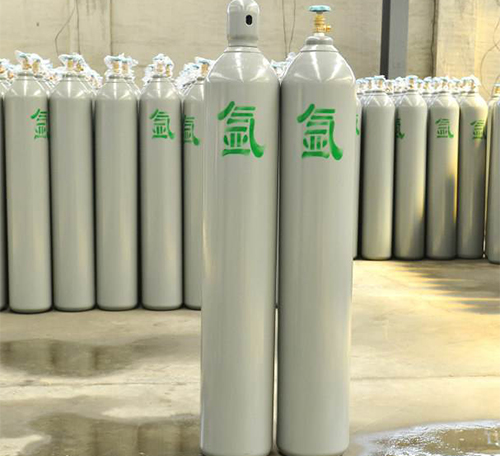
Nitrogen and argon are both inert gases! Just nitrogen is not as inert as argon, let's take a look at their properties:
Nitrogen: Physical properties:
Under normal conditions, elemental nitrogen is a colorless and odorless gas, with a gas density of 1.25g · dm-3 under standard conditions. Nitrogen becomes a colorless liquid when cooled to -195.8 ℃ at standard atmospheric pressure, and a snowy solid when cooled to -209.86 ℃.
Nitrogen has a low solubility in water, and at room temperature and pressure, only about 0.02 volume of nitrogen is dissolved in 1 volume of water. It is a gas that is difficult to liquefy. The solubility in water is very low, and at 283K, one volume of water can dissolve approximately 0.02 volumes of N2. Nitrogen will liquefy into a white liquid at extremely low temperatures, and when the temperature is further lowered, it will form a white crystalline solid. Normally, nitrogen gas supplied in the market is stored in black gas bottles.
Chemical property of nitrogen
The molecular orbital formula of nitrogen molecules is, and three pairs of electrons contribute to bonding, forming two π bonds and one σ bond. There is no contribution to bonding, but the energy of bonding and anti bonding is approximately offset, and they are equivalent to lone electron pairs. Due to the presence of a triple bond N ≡ N in N2 molecules, N2 molecules have great stability, and decomposing them into atoms requires absorbing 941.69 kJ/mol of energy. N2 molecules are the most stable among known diatomic molecules.
The use of nitrogen
Nitrogen is mainly used for the synthesis of ammonia, which is used to manufacture fertilizers, nitric acid, explosives, etc. Ammonia is also an important raw material for synthetic fibers (nylon, acrylic), synthetic resins, synthetic rubber, etc. Due to the chemical inertness of nitrogen, it is commonly used as a protective gas. To prevent certain objects from being oxidized by oxygen when exposed to air, filling the grain bin with nitrogen can prevent the grain from moldy and sprouting, and preserve it for a long time. Liquid ammonia can also be used as a deep refrigerant.
Chemical property of argon
Argon is a single atom gas with no chemical activity. It will not react with other elements or compounds. Although there have been reports that a few compounds of red and other rare gases have been prepared, it can be considered that such research only has scientific significance. For all practical applications, every attempt to combine compound compounds into common types has failed. These efforts include treating argon with oxidants and reducing agents. The reason why argon is stable is because all its electrons have completely paired and there are no bonding orbitals present
Argon is a rare gas widely used in industry at present. Its nature is very inactive, neither able to burn nor aid in combustion. In the sectors of aircraft manufacturing, shipbuilding, atomic energy industry, and mechanical industry, argon is often used as a welding protective gas for special metals such as aluminum, magnesium, copper and their alloys, and stainless steel during welding, to prevent the welded parts from being oxidized or nitrided by air.
In metal smelting, oxygen and argon blowing are important measures for producing high-quality steel, with an argon gas consumption of 1-3 cubic meters per ton of steel produced. In addition, argon is also needed as a protective gas for the smelting of special metals such as titanium, zirconium, and germanium, as well as in the electronic industry.
The 0.932% argon in the air has a boiling point between oxygen and nitrogen, and the highest content is found in the middle of the upper tower of the air separation unit, which is called argon fraction. While separating oxygen and nitrogen, extracting the argon fraction for further separation and purification can also yield argon by-products. For a fully low-pressure air separation unit, it is generally possible to obtain 30% to 35% argon in the processed air as a product (the latest process can increase the extraction rate of argon to over 80%); For the medium pressure air separation unit, due to the expansion of air entering the lower tower, it does not affect the distillation process of the upper tower, and the extraction rate of argon can reach about 60%. However, the total processing air volume of small air separation units is small, and the amount of argon produced is limited. Whether to install an argon extraction device depends on the specific situation.
Argon is an inert gas that poses no direct harm to the human body. However, if industrial use results in exhaust gases that pose a significant threat to human health, it can cause conditions such as silicosis and eye damage.
Although it is an inert gas, it is also a suffocating gas, and large inhalation can cause suffocation. The production site should be ventilated, and technical personnel engaged in argon related work should undergo regular occupational disease examinations every year to ensure their physical health.
Argon itself is non-toxic, but it has a suffocating effect at high concentrations. When the concentration of argon in the air exceeds 33%, there is a risk of suffocation. When the concentration of argon gas exceeds 50%, serious symptoms occur, and when the concentration reaches 75% or more, death can occur within a few minutes. Liquid argon can harm the skin, and eye contact can cause inflammation
How to choose?
If oxygen or water vapor needs to be isolated, inert gases such as nitrogen or argon are required.
High purity argon is more inert than high purity nitrogen. General metal organic reactions such as Suzuki coupling can react well under high-purity nitrogen. When there are metals or metal organic compounds that will react with nitrogen, high-purity argon is needed. For example, reactions related to metallic lithium need to be carried out under high-purity argon because nitrogen will react with lithium. As long as the reactants or products do not react with nitrogen, even if literature suggests using argon gas, it is not a problem to actually use nitrogen gas.
Air Separation Plant/Nitrous oxide plant/CO2 recovery plant/Hydrogen plant/Acetylene Plant/Mobile Tank/ISO Tank Container/Cryogenic Storage Tank/LPG Storage Tank/Cryogenic Pump/Micro Bulk Tank Solutions/Cryogenic Semi Trailer Transport Tanker/LPG Semi Trailer Tanker/Dewar Flask/Vaporizer/Cylinders/Dry ice making machine/Calcium Carbide
Product series : Air Separation Plant | Cryogenic Storage Tanks | ISO tanks | Semi Trailer | Vaporizers | Pumps | Dewar Flasks| Dry Ice Machines | Cylinders