
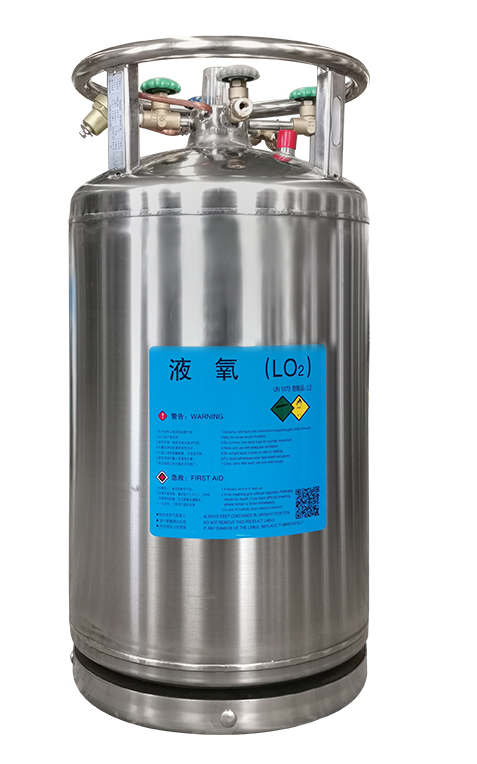
Fault 1: The pressure is too high or the pressure rise speed is too fast.
Reason 1: Low gas consumption. Method: If the daily gas consumption is less than about 2.8 standard cubic meters, the pressure will increase. The normal pressure increase should not exceed 0.35MPa (50Psi) per day.
Reason 2: Overfilling Method: If overfilling, the pressure in the bottle may rise sharply after the filling is completed. Overfilling is prohibited.
Reason 3: Improper setting or failure of the booster regulating valve Method 1: After boosting, the working pressure exceeds and maintains above the required pressure, readjust the booster regulating valve to the required pressure; Method 2: After boosting, the work pressure continues to rise until the safety valve takes off, and there is frost in the booster coil located at the bottom of the bottle, replace the booster regulator valve.
Reason 4: Loss of vacuum. Solution: Sweat or even frost on the surface of the bottle, return to the factory for maintenance.
Fault 2: Pressure is too low.
Reason 1: Excessive gas consumption. Method: Refer to the manual and use according to the recommended maximum gas consumption and pressurization capacity.
Reason 2: The booster valve is closed. Method: Open the booster valve.
Reason 3: The boost regulator valve is not fully opened. Method: Test whether the boost regulator valve works normally when the pressure is set.
Reason 4: There is a leak. Method: Check whether there is frosting or air leakage in the pipe on the top of the bottle, and conduct an airtight test.
Reason 5: The liquid temperature is too low. Method: Open the booster valve, it may take a long time to boost pressure or use external Pressure boost.
Reason 6: Low pressure take-off of the safety valve. Method: The setting of the safety valve's take-off pressure is inappropriate, and a suitable safety valve should be replaced.
Reason 7: The pressure gauge is broken.
Fault 3: The container is full but no pressure is displayed.
Reason 1: The pressure gauge is broken. Method: Replace the pressure gauge.
Reason 2: The safety valve or rupture disc is damaged. Method: Replace the safety valve or rupture disc.
Reason 3: Valve or pipeline leakage. Method: Find the leak point and repair it.
Fault 4: Frosting on the bottom of the bottle. Cause: The booster circuit is being used for boosting. Method: If the pressure in the bottle is lower than the setting value of the booster regulating valve, this phenomenon is normal and caused by the previous filling or previous gas use.
Fault 5: There is spiral frost in the middle and lower part of the bottle. It is normal to use the vaporization circuit and vaporize liquid to become gas.
Fault 6: The safety valve frequently trips. Reason: Loss of vacuum. Method: Return to the factory for repair. Reason: The safety valve setting value is low. Method: Reset the opening pressure of the safety valve.
Fault 7: The air supply temperature is too low. Reason: The air consumption is too large. Method: Refer to the maximum air consumption.
Fault 8: Frosting on the top of the bottle.
Reason 1: It is a normal phenomenon caused by the last filling or previous gas use.
Reason 2: Leakage of the level gauge. Method: After the pressure is vented, replace the sealing gasket of the level gauge, reinstall it, and test the air tightness.
Reason 3: Leakage of the boost regulator valve pipeline. Method: tighten the joint, air tightness test.