
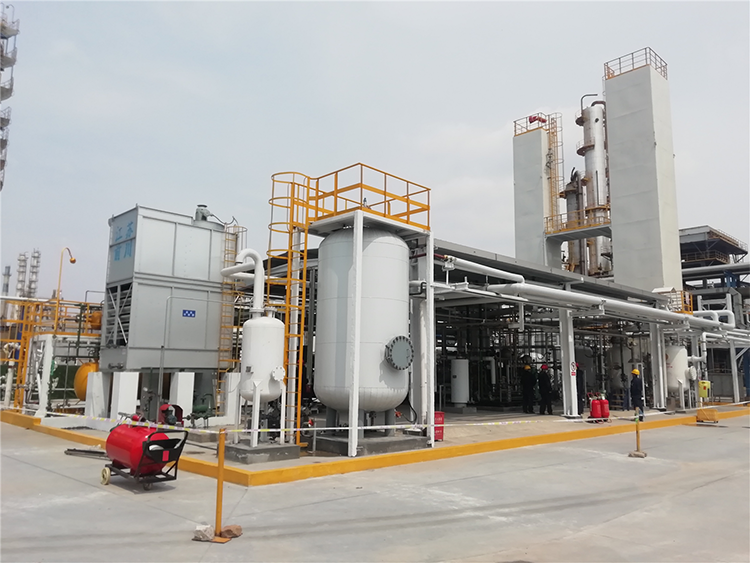
Combining discarded steel slag and carbon dioxide into bricks, using synthetic biotechnology to cultivate bacteria to "eat" carbon dioxide, using green electrolysis of carbon dioxide to produce green aviation fuel... Using eighteen martial arts techniques to transform carbon dioxide into low-cost bricks, clothing, food, and fuel - these are the "magical" effects of CCUS (Carbon Capture, Utilization, and Storage) technology, also known as the "carbon catcher".
In the context of increasing global warming, CCUS is considered the "last mile" to achieve carbon neutrality, as even if it does not emit at all, in order to reduce carbon emissions, it is necessary to capture the previously emitted carbon dioxide.
China Securities Journal reporters found through research and interviews that CCUS technology still faces significant cost constraints, with conflicting voices such as "important but not yet as important at this stage" and "urgent but also very cautious" filling the industry. Experts interviewed believe that technological and commercial innovation are important ways to achieve the economic viability of CCUS technology as soon as possible. Currently, it is necessary to promote cooperation among government, industry, academia, research, and finance. At the same time, CCUS is not a single technology, but involves multiple disciplines and interdisciplinary innovations such as chemical engineering, geology, energy, and materials. It is a multi-dimensional and complex system with long links, cross fields, and multiple routes, and also requires more systematic deployment and diversified support methods.
Bottom up technical solution
In the view of Xu Hao, Vice President of Sustainable Social Value at Tencent, CCUS technology is somewhat similar to a "bottom-up" technology.
According to the International Energy Agency, in order for the global energy system to achieve zero emissions by 2050, CCUS emissions reduction needs to reach 8%, while the current figure is only 0.13%. Only by starting today, by 2050 and 2060, can these technologies mature to scale up and be low-cost, "Xu Hao told China Securities Journal reporters.
Especially considering China's coal based resource endowment and energy structure characteristics, CCUS technology can significantly reduce carbon dioxide emissions from the source, which is of great strategic significance for achieving carbon neutrality goals.
According to the Annual Report on Carbon Capture, Utilization and Storage (CCUS) in China (2023), it is predicted that under the "dual carbon" target, China's CCUS carbon dioxide emission reduction demand will be 24 million tons/year in 2025, nearly 100 million tons/year in 2030, 1 billion tons/year in 2040, over 2 billion tons/year in 2050, and 2.35 billion tons/year in 2060.
Looking at different industries, considering China's current installed power generation capacity and hard constraints on energy security, the thermal power industry will be the focus of CCUS application, and it is expected to achieve 1 billion tons/year of carbon dioxide emissions reduction through CCUS by 2060; After improving production efficiency and reaching peak production, industries such as steel, cement, and chemical will still need to reduce some carbon dioxide emissions through CCUS.
Xu Hao expressed confidence in achieving CCUS emissions reduction of 100 million tons of carbon dioxide by 2030. In March 2023, Tencent and its industrial partners launched the largest funding program in the CCUS field in China, the "Carbon Search Program," which received over 300 project applications nationwide. During the investigation of these projects, he found that China has participated in all technological innovation points along the CCUS technology industry chain, including state-owned enterprises, research institutions, and start-up enterprises, showing an active trend.
In recent years, China's CCUS technology and demonstration have made significant progress, with the ability to design large-scale carbon dioxide capture, pipeline transportation, utilization, and storage systems. Technically speaking, both in terms of technological maturity and advanced level, we are on par with Europe and America and are in the stage of industrial demonstration. However, Europe and America are more advanced in scale, with the United States having many large-scale demonstration projects compared to us. In addition, in some areas such as pipeline transportation and offshore storage, we are lagging behind compared to the international community
In order to break through the bottleneck of CCUS industrialization development, the State owned Assets Supervision and Administration Commission of the State Council recently launched the construction of the third batch of central enterprise innovation consortia, focusing on key areas such as strategic emerging industries and future industries, supporting central enterprises to continue building 3 and establish 17 innovation consortia in industrial software, industrial mother machines, new energy and other directions. Among them, China Petroleum and China Huaneng jointly led the establishment of the CCUS Innovation Consortium, aiming to lead the high-quality development of China's CCUS industry.
According to China Huaneng, as the earliest domestic enterprise to carry out carbon dioxide capture and carbon dioxide oil recovery and storage, the group and China Petroleum are jointly building the world's largest coal-fired power plant 1.5 million tons/year CCUS demonstration project in Huaneng Longdong Energy Base. In the future, the demonstration project will be used as a driving force, and the long-term goal is to build a CCUS industrialization capacity of tens of millions of tons.
In the early stages
The significant strategic value of CCUS technology is widely recognized within the industry, and it is widely acknowledged that cost is the biggest constraint for further promotion and application of CCUS. Although CCUS technology is indispensable in the long run, it is currently in a relatively early stage of development overall.
The Annual Report on Carbon Capture, Utilization and Storage (CCUS) in China (2023) believes that although CCUS technology in China is developing rapidly, it is currently facing challenges such as high application costs, lack of effective business models, insufficient incentives and regulatory measures, and difficulties in source sink matching. There is still a gap between large-scale commercial operation.
China's CCUS technology includes the concepts of CCS (Carbon Capture and Storage) and CCU (Carbon Capture and Utilization). The cost of CCS is the biggest obstacle to its commercialization and industrialization. Considering current costs, the industry generally believes that large-scale use of CCS before 2030 faces significant technology lock-in risks. "Zhang Xian said that according to the current CCUS technology cost calculation, taking power plants and cement plants as examples, after installing CCS, the cost per kilowatt hour and per ton of cement will increase by more than 50%, and after installing CCS in steel plants, the cost per ton of steel will increase by more than 15%. If we consider achieving future global climate goals or national carbon neutrality targets, installing CCUS will significantly reduce global or national emission reduction costs.
CCUS technology involves multiple stages, including capture, utilization, and storage technologies. Zhang Xian stated that there is a significant gap in the maturity of various CCUS technologies. Taking carbon dioxide capture as an example, direct air capture technology is still in the laboratory stage, while carbon dioxide capture technology for point source emissions from power plants has reached the demonstration stage. The maturity of carbon dioxide utilization is relatively high, and if opportunities can be seized before 2030, there will be more profit potential.
Nicholas Mulei Musyoka, Associate Professor of Renewable Energy and Energy Storage at the Innovation Research Institute of the Excellence Lighthouse Program (Ningbo) at the University of Nottingham, stated in an interview with China Securities Journal that there are different technological development paths in the CCUS field, and it is necessary to comprehensively develop various technology chains and consider their future potential. In CCU technology, the Power-to-X pathway will play a key role, which involves producing green hydrogen from renewable energy sources and reacting it with captured carbon dioxide to produce sustainable synthetic fuels and chemical products. At the same time, the market needs to accelerate the exploration of CCU technology that is more attractive and cost competitive.
Xu Hao found that the vast majority of startups related to CCUS are currently working on CCU, which converts carbon dioxide into basic industrial raw materials such as methanol, butanol, and calcium carbonate. Even though we don't have a clear carbon price incentive today, there are already CCUS startups that can carry out market-oriented development, which means that the potential of this technology is very great, making us believe that CCUS has great prospects, "said Xu Hao.
The project that left a deep impression on Xu Hao was the cultivation of Clostridium perfringens using synthetic biotechnology by Nanjing Shiqi Biochemical Technology Co., Ltd., which "allows bacteria to eat CO2" to form butanol. Compared to the traditional petroleum butanol route, this has the potential to reduce production costs by 20% -50%.
There are quite a few people exploring CCUS, which involves electrolyzing carbon dioxide into X. The products obtained from this reaction are very rich, "said Wang Xiuping, CTO of Carbon Energy Technology, in an interview with China Securities Journal. Her company, Carbon Energy Technology, was founded in 2015 and is committed to providing economically positive "carbon neutrality" solutions for the carbon emission industry. Through independently developed catalysts, electrolysis reactors, and "carbon capture utilization integration" process route design, combined with green electricity, it efficiently converts carbon dioxide into green chemicals and new materials with industrial application value such as synthesis gas, synthesis oil, methanol, etc. In May of this year, the technology of producing synthesis gas from 100 ton electrolytic carbon dioxide was shortlisted for the "Recommended Catalogue of Energy saving and Carbon Reduction Technology Equipment in the National Industry and Information Technology Field (2024 Edition)" by the Ministry of Industry and Information Technology.
Wang Xiuping introduced that in 2020, the company cooperated with Inner Mongolia Yitai Group to complete a pilot test certificate of 30-50 tons/year carbon reduction. After searching and updating by the China Chemical Industry Information Center, it was the first of its kind internationally, making this technology route the first in the world to move from laboratory to engineering scaling up. In 2024, the company cooperated with Hengshan Coal and Electricity Company of Yulin Energy Group and Yuneng Research Institute to carry out industrial demonstration research on 500 tons/year carbon dioxide electrolysis to produce synthesis gas using integrated carbon dioxide enrichment conversion technology. The flue gas from thermal power plants was used as raw material to convert carbon dioxide into synthesis gas through electrolysis. All key equipment has been delivered to the site and entered the stage of single machine commissioning.
However, Wang Xiuping admitted that the overall attitude of the customer side towards CCUS is "urgent and cautious". "Currently, everyone is mainly conducting more demonstration and verification on the maturity, reliability, economic viability of carbon cycling, and application scenarios of the technology
According to Wang Xiuping's analysis, the reason why cost constraints are still relatively high is that fixed investment has not yet achieved economies of scale. At present, key materials, components, and equipment are mostly customized, resulting in high processing and manufacturing costs; Secondly, the operating cost of carbon dioxide electrolysis is mainly due to high electricity costs. In the future, as the cost of green electricity continues to decline, it will be beneficial for the promotion and application of this technology; Thirdly, green products do not have a premium and are sold at an equivalent price to traditional fossil products, which cannot reflect their green value.
We are committed to improving electrolysis efficiency through breakthroughs in material properties, upgrading reaction equipment and processes, and striving to overcome cost constraints, "said Wang Xiuping.
Join forces to cross the 'Valley of Death'
Zhang Xian emphasized that the most important way to reduce technology costs in the future is to accelerate technology research and development demonstrations, accelerate CCUS technology iteration, "for example, capturing second-generation technology can reduce costs by more than 30% compared to first generation technology
Wang Xiuping stated that investing heavily in CCUS technology research and innovation to reduce CCUS costs is a key factor in achieving large-scale commercial development of CCUS. She suggested that China can carry out core technology research and development around various links of CCUS and establish special research and development funds to provide support for the full process technological innovation of CCUS.
The most crucial thing now is how we can promote technological innovation and make the technological iteration process as fast as possible, because carbon dioxide is still continuously emitted into the atmosphere. We need to do this with a more urgent timetable, conduct research and development, pilot projects, and scale up as soon as possible, cut down costs, and achieve large-scale applications. "Xu Hao said that this is also the original intention of Tencent's" Carbon Search Plan ". We have partnered with partners including Hebei Iron and Steel Group, China Resources Group, and Conch Group to provide billions of yuan in funding and resource support for outstanding projects, in order to help these cutting-edge technologies move out of the laboratory and into the first step of industrialization, "said Xu Hao.
Xu Hao said that the projects on the final selection list of the "Carbon Search Plan" will gradually complete pilot construction this year and next year, hoping to become the "best available technology" in the CCUS field and promote the formation of a real industry for CCUS in China. The second phase of this year's "Carbon Search Plan" will expand to search for cutting-edge low-carbon technologies worldwide. Based on CCUS and carbon removal technologies, it will cover more innovative technologies such as long-term energy storage, and cooperate with more domestic and foreign industry partners to help technology cross the "valley of death" globally.
In addition, a good market incentive mechanism is also the key to revitalizing the industry. Zhang Xian believes that the experience of relying on the market to promote technological progress and promotion in Europe and America is worth learning from, especially in creating a better price transmission mechanism to accelerate technology promotion.
Meng Bingzhan, Chief Dual Carbon Officer of Zhongchuang Carbon Investment, believes that the development of CCUS requires more diversified support methods. Including CCUS in the voluntary greenhouse gas emission reduction trading market can obtain additional market funding support. Recently, the National Environmental Technology Standardization Committee has been soliciting opinions on the national standard "Technical Specification for Quantification and Verification of Greenhouse Gas Emissions Reduction in Carbon Capture, Utilization and Storage (CCUS) Projects", which will further promote the quantification of CCUS project emissions reduction and the marketization of trading work.
For CCUS, everyone's focus is mainly on cost, and CCUS is still seeking new models for coupled development with new energy and industrial systems Wang Xiuping suggested that the CCUS project involves multiple collaborative links, and a full industry chain linkage platform for upstream, midstream, and downstream should be established to accelerate the exploration from the point to the systematic layout; At the same time, CCUS has not yet followed standards in technology promotion, project construction and management, risk management, and other aspects. It is necessary to improve evaluation standards, strengthen standard measurement and certification system construction, and enhance CCUS carbon footprint research and accounting.
Air Separation Plant/Nitrous oxide plant/CO2 recovery plant/Hydrogen plant/Acetylene Plant/Mobile Tank/ISO Tank Container/Cryogenic Storage Tank/LPG Storage Tank/Cryogenic Pump/Micro Bulk Tank Solutions/Cryogenic Semi Trailer Transport Tanker/LPG Semi Trailer Tanker/Dewar Flask/Vaporizer/Cylinders/Dry ice making machine/Calcium Carbide
Product series : Air Separation Plant | Cryogenic Storage Tanks | ISO tanks | Semi Trailer | Vaporizers | Pumps | Dewar Flasks| Dry Ice Machines | Cylinders